
I’ll walk you through how I launched a brand-new Shopify store in the supplement niche for a client. Nobody had heard of this brand, and we used no paid ads, affiliates, influencers, or email list. It still earned a Google Knowledge Panel, AI brand mentions, and its first subscription signups in under 30 days. You will see the complete launch step by step, with the results, the mistakes, and what to avoid. My name is Michal Sieroslawski, and I helped launch several Shopify brands using an SEO sequence designed to put every signal in place before search engines and AI engines were allowed to crawl the site.
What I am covering in this case study is what most Shopify launch guides skip. Most guides on how to start a Shopify store end once the theme and payments are set up. This one covers what comes after setup: the steps to launch a Shopify store so Google and AI assistants can find it. Picking a theme, setting up Shopify Payments, configuring shipping zones, uploading mockup product pictures, and slapping AI-generated product descriptions using Shopify Sidekick is not enough for a successful launch. Worse, it tanks the launch. The only people who ever see the store are family and friends.
A Shopify store launch is the process of making a Shopify ecommerce store live and available to customers, search engines, and, most importantly, AI agents. A Shopify store launch includes configuring product pages, collection pages, homepage content, blog articles, buying guides, internal linking, navigation structure, the contact page, policy pages, and technical SEO setup before the password comes off and the store opens to the public. A successful Shopify store launch also includes generating branded search demand and building out consensus and a stellar reputation around your brand on third-party websites, news sites, and blogs before it even launches.
A Shopify brand launch is a sequential SEO process done with engineering precision, not a nice-to-have checklist.
A Shopify SEO sequence means building on-site content, off-site signals, and brand awareness before the store opens to the public. On-site content means conversion-optimized product pages, collection pages, blog articles turned into landing pages, buying guides, and other pages that convert visitors into customers. Off-site signals are external references and recommendations about your products, user signals, and backlinks from other websites. Brand awareness means people knowing your brand name and searching for it on Google. It comes from a launch press release, consistent social profiles, and a branded search campaign that builds demand before launch. The goal is to earn trust and pass the quality threshold of search engines and AI agents. The brand is ready to launch when search engines and LLMs recognize it as a real entity and the open web has signals pointing to it.
The Shopify brand launch case study covers a supplement store launched on November 11, 2024, on a brand-new domain with zero prior history. The brand name was invented from scratch (to be unique, because the niche is highly competitive), and the domain pairs it with the product category, a partial-match domain (PMD). The store was built on Shopify’s free Dawn theme, with custom code changes. The store remained password-protected for weeks while it was in development, before it moved into production. Shopify sessions from November 1–10 were admin and development activity, so the case study begins on November 11.
The brand name and domain stay private because this was a client engagement under NDA, but every number, date, and screenshot is accurate.
What the project did NOT have at launch:
- No email list
- No existing customer base
- No social audience
- No PR contacts
- No Amazon listings
- No partnerships with influencers
- No prior content anywhere on the web
- No backlinks
- No marketing budget for paid ads
- No branded search volume
- No founder name recognition
- No customer reviews
- No agency support
What the project HAD by day 30:
- A Google Knowledge Panel
- A Google Trends breakout for the brand name
- 20 monthly searches for the branded keyword
- Google Autocomplete suggestions for the brand name
- AI mentions from ChatGPT, Perplexity, and AI Overviews
- 27 published long-form articles
- 50+ product pages
- 20+ collection pages
- 12 verified Trustpilot reviews
- 150+ third-party listicles naming the store the top pick for its category
The results at a glance:
- Indexed by Google 11 hours after the password came off
- 1,045 ranking keywords by day 30, and 3,200+ by day 50
- 5.62K clicks and 262K impressions in the first 74 days, with no paid ads
- Sales up 167% in December and another 550% in January, about 17 times the launch month
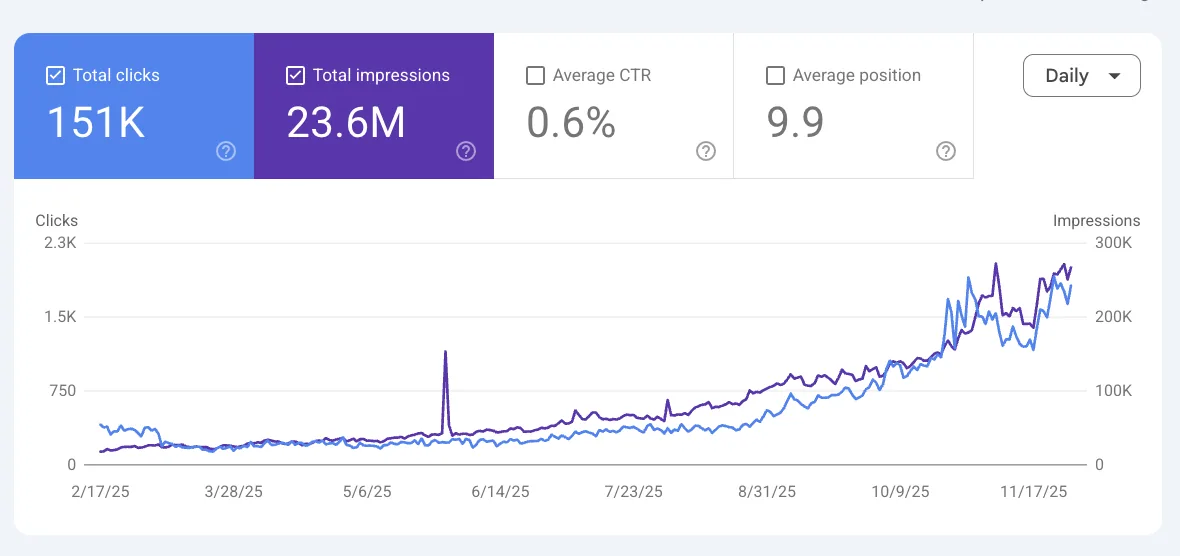
- 151K clicks and 23.6M impressions in the following nine months, at an average position of 9.9
See the full day-by-day results →
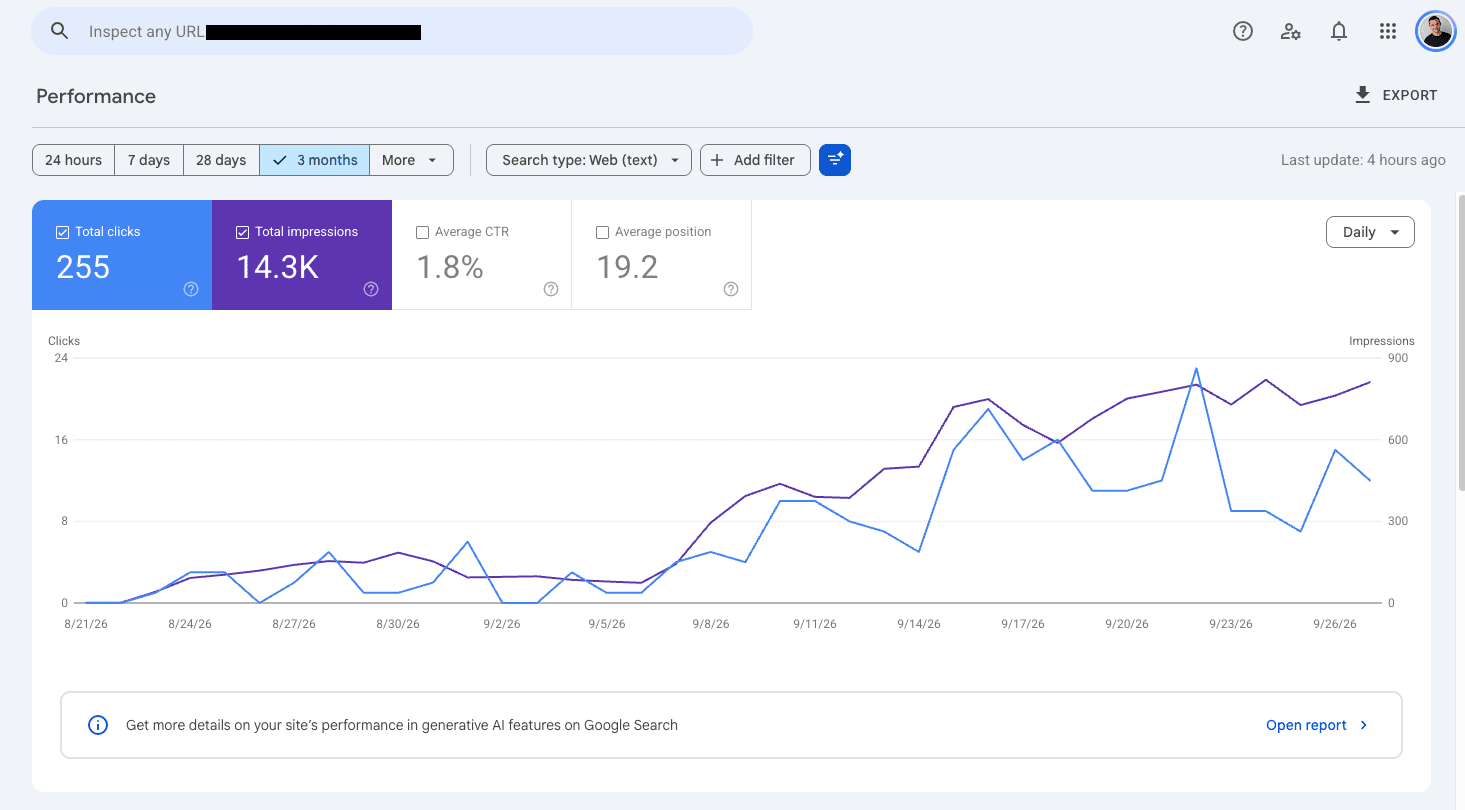
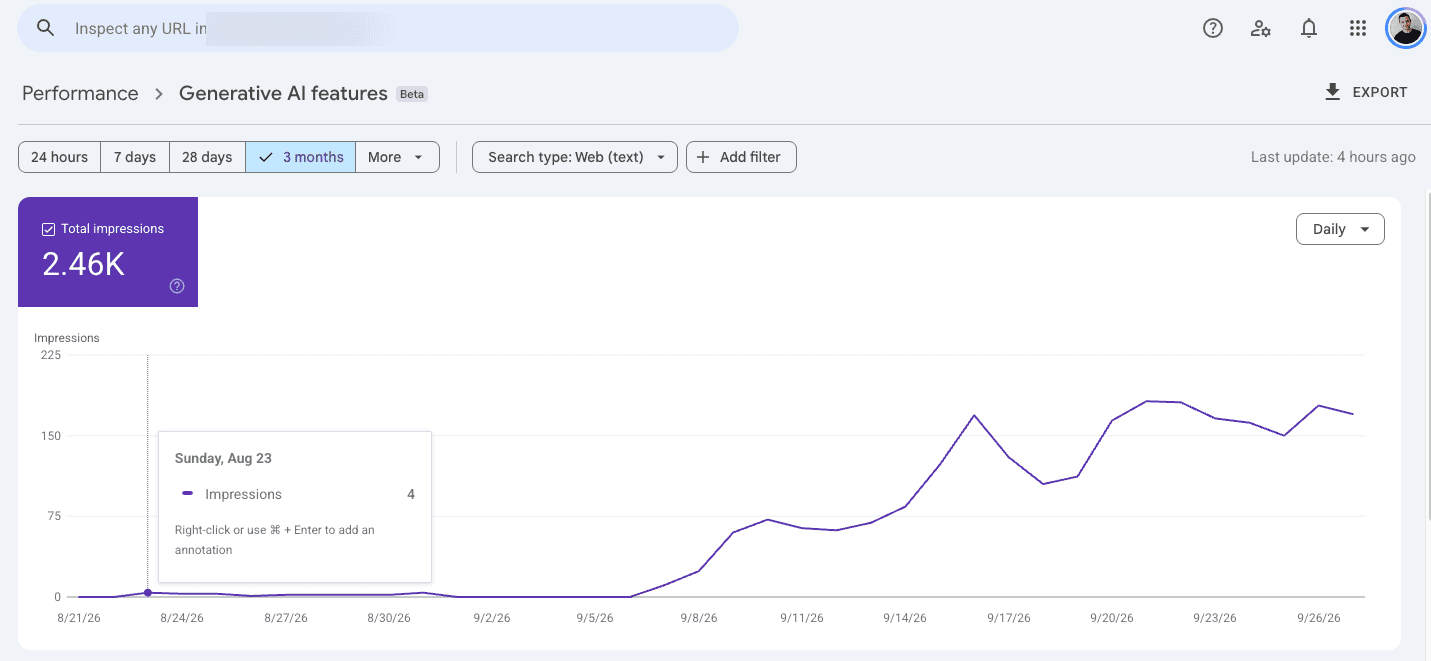
This is not a one-time win
The chart above isn’t a one-off tied to one niche or one brand. I’ve run the same sequence on other Shopify brands, and the shape repeats: a slow start while Google assesses the site, an inflection point as the domain enters the index at a higher starting position, then a multi-month climb across both head and long-tail queries. The two charts below come from a recent launch for another Shopify brand in a smaller niche, with the same pre-launch on-site network, third-party articles, and brand-recognition work. Covering that niche end to end takes 60 articles, and these results came from only 10 live ones. That store runs as a headless Shopify storefront built with Astro, which I’ll cover in a separate case study.
Here’s the exact launch strategy I ran, step by step.
1. Choose a unique brand name and domain
Choose a unique brand name and secure a matching domain. It’s one of the first steps to launch a Shopify store, because every other signal points back to the name. For this project, I created the brand name from scratch and paired it with the product category in the domain (brand + category.com). A distinctive name helps Google and AI assistants identify the brand as a unique entity in a competitive niche. It also makes results easy to track, because every search for the name is about your brand.
An invented name builds a distinct brand, but it gives Google little initial context about the site’s topic. Adding a category or keyword makes the topic clearer. Choose a brand-only domain, such as nike.com or glossier.com, or use an exact-match domain (EMD) or a partial-match domain (PMD). An EMD matches the target keyword, such as cbdfordogs.com. A PMD combines the brand with the target keyword, such as pawlycbd.com.
A brand-only domain builds a cleaner long-term brand. starbucks.com, nike.com, and glossier.com omit category words because these brands built enough recognition for customers to know what they sell. A short domain also gives your brand room to expand into adjacent categories without tying it to one product line.
Protect your brand by securing both gogbakery.com and gog.com upfront when possible. If your business grows, someone could register the shorter domain or a lookalike and use it for a copycat store. CTM360 identified more than 30,000 fake stores impersonating over 350 fashion brands. WIPO handled more than 6,200 domain name disputes in 2025, its highest annual caseload on record. AI website builders also make copycat stores faster to create. If you cannot secure both domains, register your brand across the TLDs you can reasonably afford. The shorter domain may otherwise need to be purchased or disputed later.
2. Build product and collection pages before launch
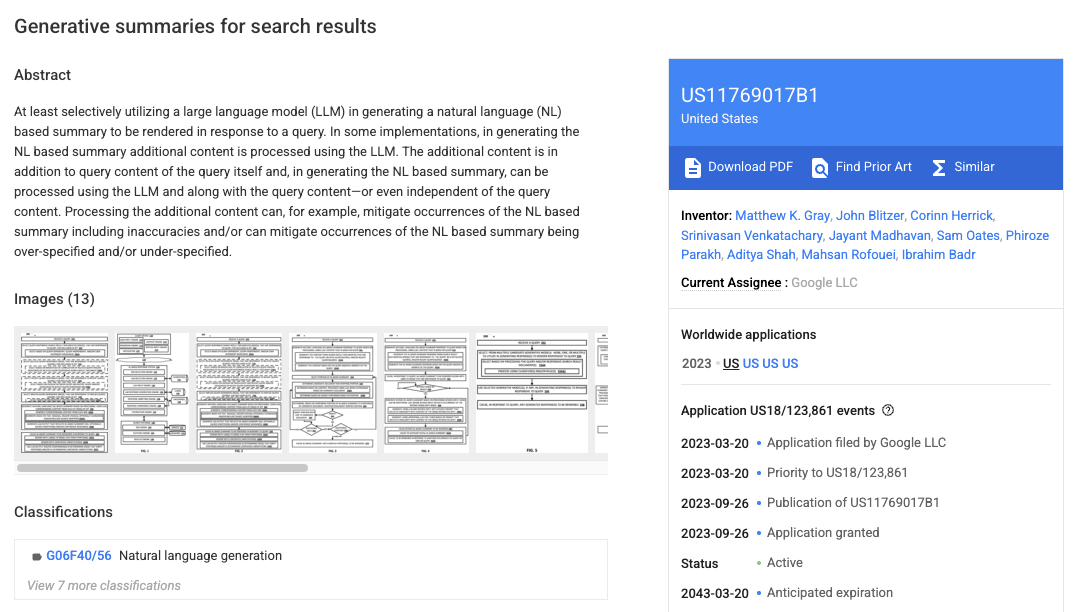
Building product and collection pages before launch means your store already has a full catalog when Google crawls it for the first time. Google judges a new site on what it finds the first time it crawls. When Googlebot first crawls a new website, Google runs expensive algorithms to check its quality and compares it with similar websites in its niche. Google’s Predicting Site Quality patent, granted in 2017, describes how Google scores a new site that has no quality score yet. It compares the phrases on the new site against a model built from sites it has already scored. So what’s on the site when Google first sees it shapes the score it starts with.
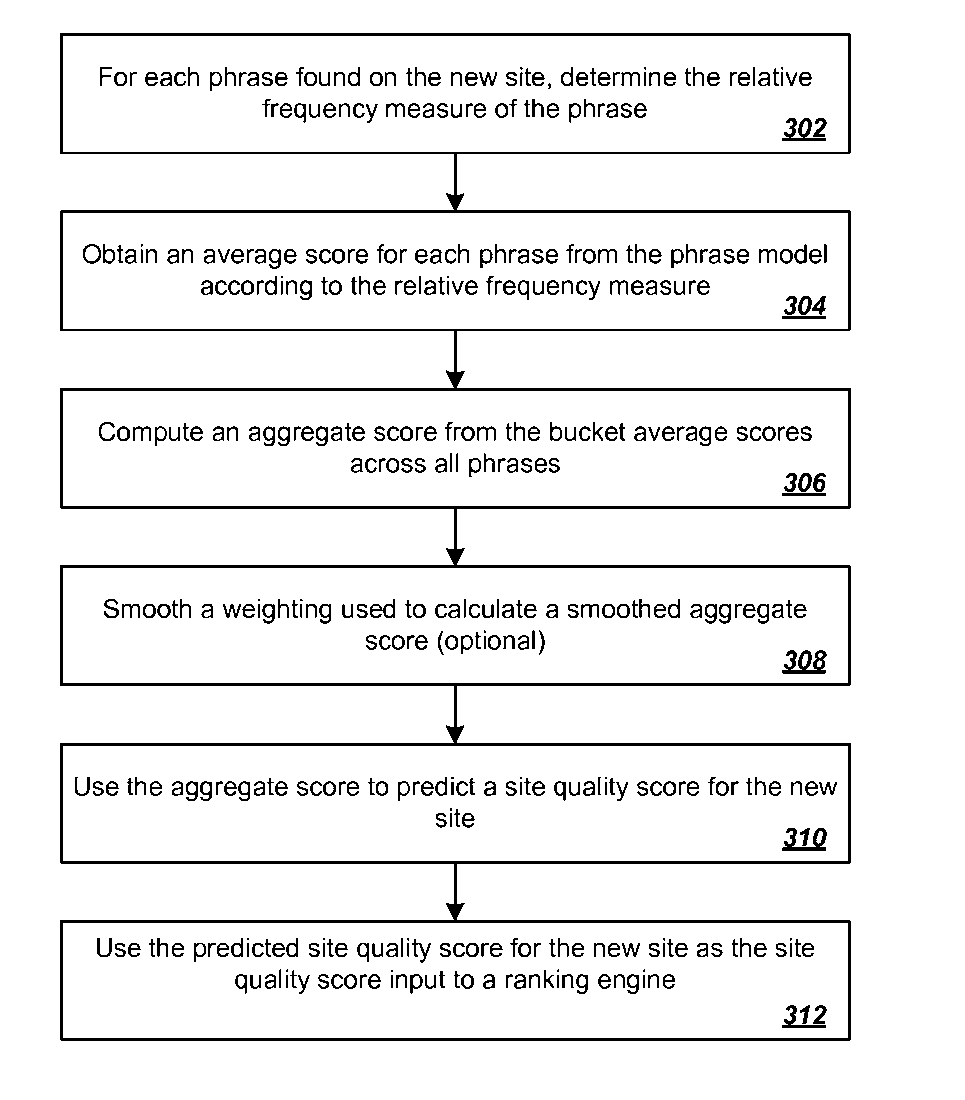
Here’s how the patent describes it. First, Google builds a phrase model from sites it has already scored. The model maps how often each phrase appears to the quality scores of sites that use it.
For a new site, it measures how often each phrase appears. It looks up each phrase’s average score in the model and combines them into one aggregate score. That becomes the new site’s predicted quality score, which the ranking engine then uses.
For example, take a founder starting an online organic skincare store on Shopify with just thin product pages. The store’s phrases get compared against hundreds of established sites in a category where Google expects extensive content with topical depth. The gap is too wide, so the store scores low. Google crawls lower-quality sites less, because crawl demand depends on a site’s size, update frequency, page quality, and relevance compared to other sites.
Since the site doesn’t pass the initial quality threshold, it gets crawled but not indexed. Or it gets indexed, but its quality is too low to rank. That also makes the store far less likely to show up in Google’s AI answers. AI Overviews are written from pages that already rank for the query, according to Google’s Generative Summaries for Search Results patent. So the store rarely gets cited as a source, let alone recommended. And because Google scores quality across the whole site, a low score drags down every page on the domain, including new ones.
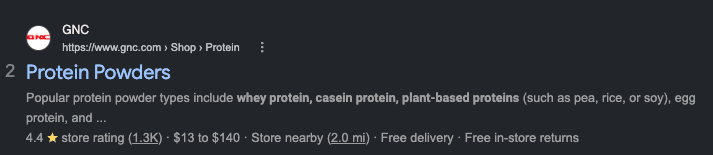
Each product page is a separate document that Google must crawl and index. Match each product page to what users search for. If you sell French roast coffee, name and optimize the product around French roast coffee instead of unrelated names like Harry’s Blend or Johnny’s Bean. Match the URL slug, meta title, H1, and product description to the user’s search intent.
Your product pages should cover every attribute relevant to your product. For example, a new Shopify store selling running shoes needs more than prices, basic descriptions, sizes, and colors. State whether each shoe is built for road running, trail running, racing, or daily training. Explain how it fits, including whether it runs true to size and how much room the toe box has. List the heel-to-toe drop and stack height in millimeters, plus the weight of each shoe. Also describe how soft the cushioning feels, how stable the shoe is, and how well the outsole grips on wet roads. A page without these details looks thin next to competitors that cover each one.
Having a handful of genuine customer reviews before actively promoting a store builds buyer trust and provides useful product feedback. Reviews may also support eligible product structured data, including AggregateRating and Review markup. Full Product schema is important before launching an online store because it gives Google structured product, offer, shipping, return, rating, and availability data from the start. Complete and accurate markup makes eligible product pages easier for Google to understand and qualify for enhanced product search experiences.
The project in this case study had a limited time and budget, so on launch day the store opened with 20 product pages, 6 collection pages, and 12 long-form articles. So how many products should you start with on Shopify? There’s no fixed number, but every product you launch with needs a complete page. And to be frank, that is not the ideal volume. The brands I launch today in similar competitive niches open with closer to 30 to 50 articles and a deeper collection structure, because the wider the on-site network at first crawl, the higher Google scores the domain. But even at that lighter volume, I personally wrote every page with higher detail, greater topical depth, and clearer connection to commercial intent than the average competitor. The product pages had real product images, comparison tables, and full attribute coverage. The collection pages followed the same structure. The articles covered the most important attributes in the niche end to end, so from day one Google classified the domain as a high-quality source alongside established competitors.
3. Publish informational articles that point to your products
During those first 30 days, I kept publishing informational articles. They covered topics directly related to the products and answered the questions customers were asking. Here’s the funny part. That goes against what most marketers teach today. Search YouTube, TikTok, Instagram, or Google for ecommerce SEO strategies, and you’ll see the same advice: stop writing informational blog posts because informational traffic rarely converts directly into sales. Many Shopify gurus claim articles are no longer worth writing because AI answers informational questions directly. Instead, they tell brands to focus on bottom-of-the-funnel content, including product, collection, and comparison pages that target buyers. Advice about AI visibility follows the same pattern. Search “how to get recommended by ChatGPT,” and you’ll hear that strong product pages and structured product data are all you need.
That’s the exact opposite of how SEO works. Besides the fact that clicks on informational articles help lift your whole site (which I will cover later), Google’s Personalized Search Result Ranking patent describes using search-result selections, including clicks, to personalize rankings for a user. It notes how often, how recently, and how long they stayed. When those results appear again in that user’s later searches, Google can rank them higher. In other words, a site you already chose once gets a head start the next time.
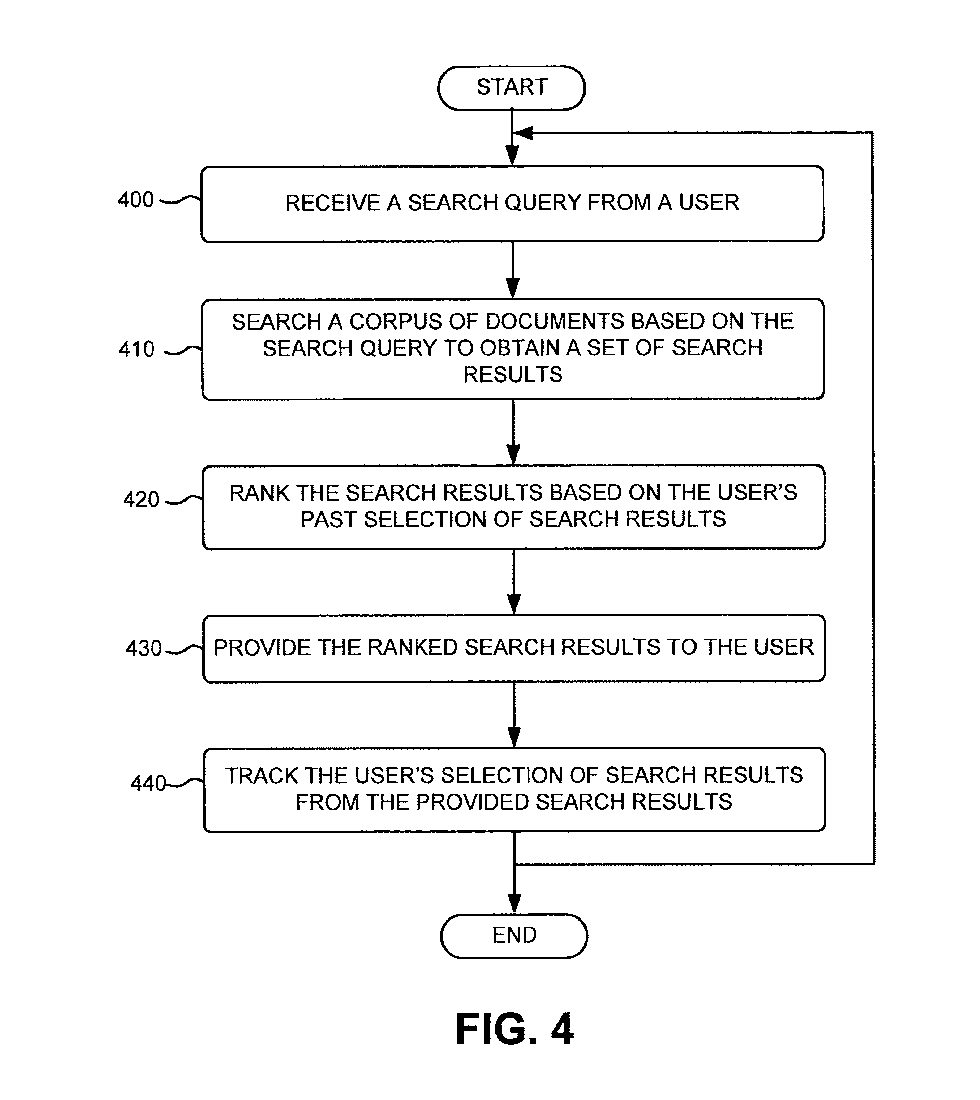
Here’s a simple example. User A reads a guide to the best snorkeling spots in Cozumel, Mexico. The guide sits on a website that earns commission on cruise bookings. Three months later, User A searches for cruise deals to Mexico from New Orleans. User A already chose that website once, so the patent describes Google ranking it higher for them.
And User A’s click doesn’t only help User A. Google’s Modifying Search Result Ranking Based on Implicit User Feedback patent describes learning from many people’s clicks, and even grouping users by how they click. So when User B later searches for cruise deals to Mexico from New Orleans, that same website can rank higher for them too. Every reader who chooses your article adds to the signal Google collects about your site.
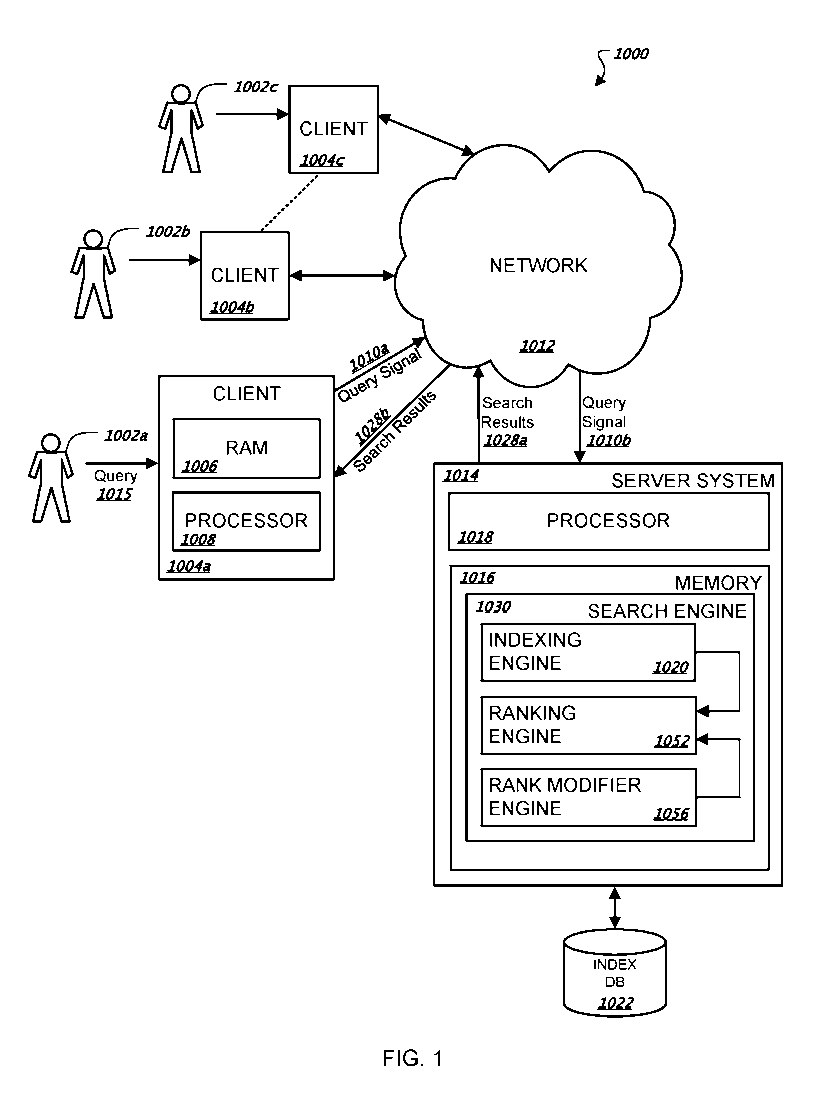
In my experience, articles are still worth writing for Shopify SEO, but their role has changed. It is true that AI answers reduce clicks for simple informational queries, but this doesn’t mean you get no traffic. Writing informational articles is important for rankings because they answer relevant search queries, build topical coverage, and attract qualified organic clicks. Helpful articles can generate satisfying clicks and longer engagement when they solve the searcher’s problem. Clicks are important because Google uses click data to evaluate how users interact with search results. The 2024 Google leak documented NavBoost signals including goodClicks, badClicks, lastLongestClicks, impressions, and clicks. Google testimony in the DOJ antitrust trial also confirmed that NavBoost uses historical click data to help adjust search results. In plain terms, Google remembers which results people click and stay on, and uses that history to move pages up or down.
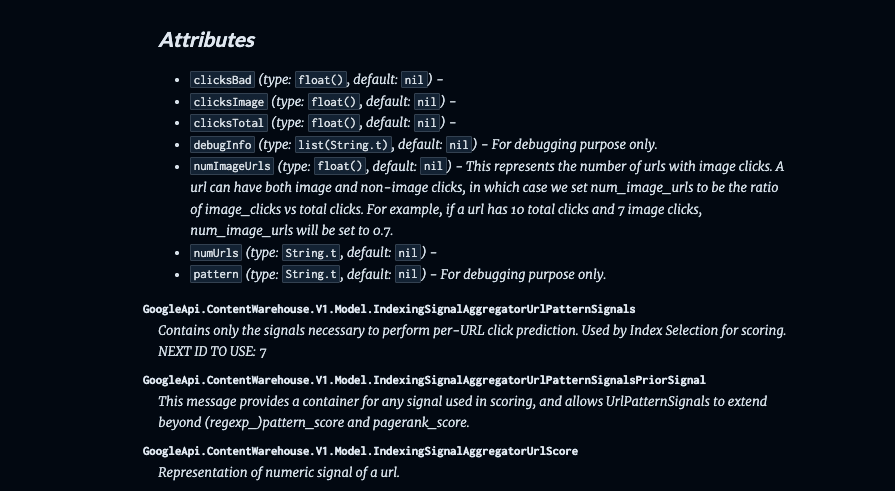
Google can analyze what users do after clicking a search result, not just the initial click. For example, a user searches “how to fix a leaking tap.”
- Page A: The user cannot find the answer and quickly returns to Google. SEO analysts describe this interaction as a
badClick. - Page B: The user finds clear instructions, stays on the page, and stops searching. SEO analysts describe the final result that retains the user as a
lastLongestClick.
NavBoost uses aggregated click-related data to help Google adjust search results.
When I write about health-related products that people eat, consume, apply to their skin, or use on their bodies, I cite relevant studies that directly demonstrate the claimed effects instead of relying on my opinion. Cite a study in prose by naming the researchers, publication year, study population, intervention or exposure, measured outcome, and key finding. Include named entities that establish who conducted the research, when and where it occurred, what was studied, who or what was studied, and the quantified result. When I write about hobby-related products, I provide first-hand experience to show AI assistants and search engines that I have personally used the products or participated in the activity.
By the end of the first 30 days, the store had 27 informational articles, each one explicitly connecting its topic to a specific product. Every article had clear CTA buttons and internal links to commercial pages, signaling the store’s commercial intent and purpose to Google.
4. Connect products, collections, and articles with internal links
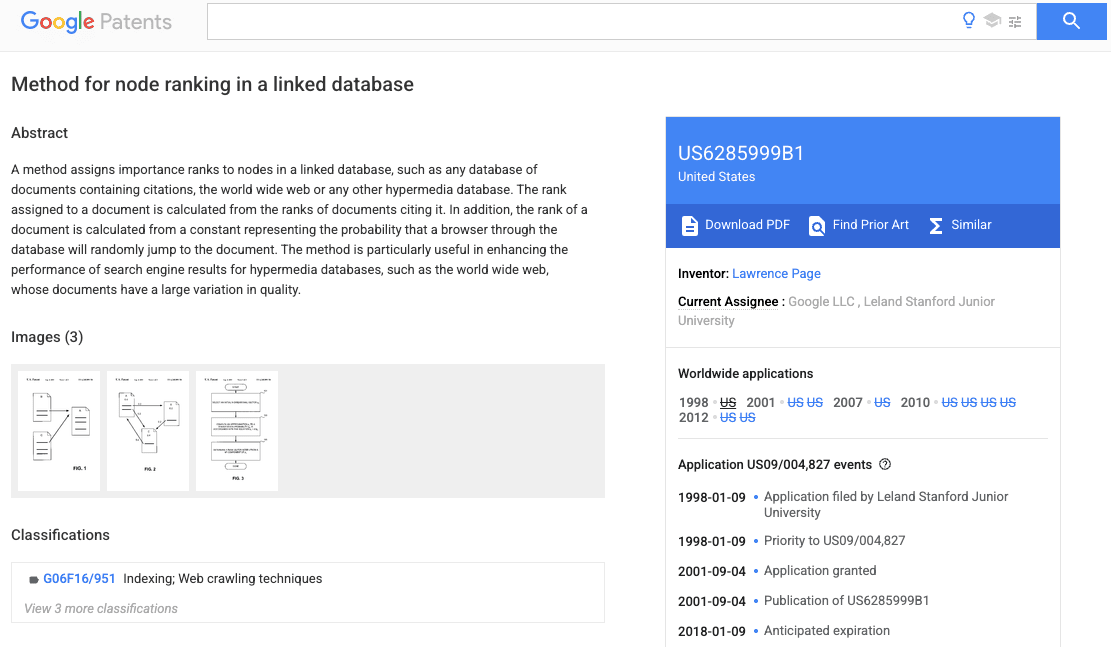
Internal links can help product and collection pages rank higher by helping Google discover pages, understand site structure, and pass PageRank between URLs. Google explicitly states that it uses links as a signal when determining the relevancy of pages. PageRank, first described in Larry Page’s US6285999B1 patent filed in 1998, ranks a page by the importance of the pages that link to it.
I wrote every article in this project with a specific purpose. I used informational content to generate clicks, collect user data, increase impressions, and improve the site’s overall visibility. I also used each article to create top-of-funnel brand exposure. I made sure every article was semantically connected to the products the brand was selling. I did not write random articles about topics unrelated to the products.
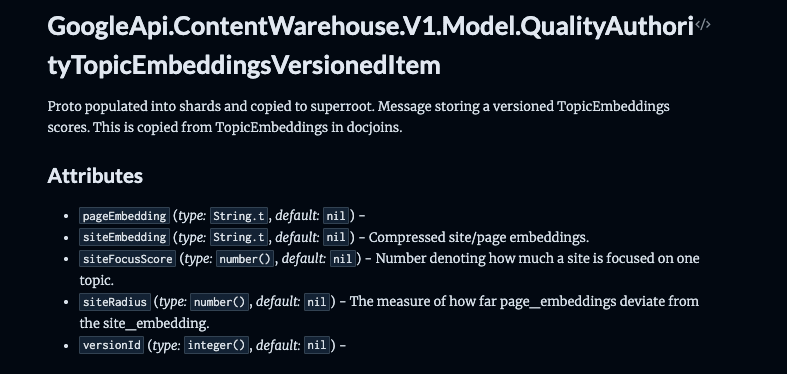
Writing articles that match your store’s purpose is important because Google’s leaked Content Warehouse documentation contains siteEmbedding, pageEmbedding, siteFocusScore, and siteRadius attributes. siteEmbedding represents the site’s embedding, pageEmbedding represents an individual page’s embedding, siteFocusScore measures how focused a site is on a topic, and siteRadius represents how far page embeddings deviate from the site embedding. Closely related pages can remain nearer the site’s topical center, while unrelated content may sit farther from it. For example, a Shopify brand that sells pet supplements should keep its articles focused on pets, pet health, nutrition, ingredients, and related topics. Based on how the leak describes siteRadius, unrelated fashion, travel, or parenting content can sit farther from the site’s topical center. The leak documents these attributes but does not reveal their ranking weights.
End every informational article by connecting the topic to your store’s products. For example, an article covering nine muscle-building tips for people over 50 on a Shopify store that sells creatine should include a clear section explaining how people over 50 can use creatine to support muscle growth, with an internal link to either the product or the collection page.
Link each informational article to a relevant product and add a clear CTA button with the product image. This gives Google and AI assistants more context about your store and helps convert readers into first-time buyers.
Blog visitors are less likely to convert because they often seek information rather than make an immediate purchase. For a Shopify brand I helped launch, blog visitors converted at about 0.06%, compared with about 2.2% for visitors landing on the homepage, product pages, or collection pages. That’s a gap of roughly 37×. But that 0.06% doesn’t mean the blog generated no sales. About 20% of the brand’s sales started with a visit to the blog, because many buyers found the brand there first and bought directly after reading an informational article.
5. Set up consistent business and social profiles
Setting up consistent business and social profiles is important because it builds trust, strengthens brand recognition, and helps customers find accurate information. Using the same business name, address, phone number, website, branding, and key details across platforms also gives search engines consistent information about your business.
Active social profiles are important because they strengthen your brand’s online presence, keep business information current, and give customers additional ways to find and verify your business. For Shopify brand visibility, maintain relevant platforms such as LinkedIn, Facebook, Instagram, YouTube, and other industry-specific profiles.
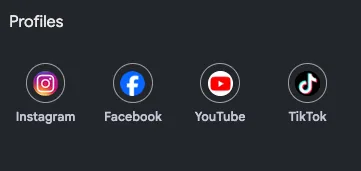
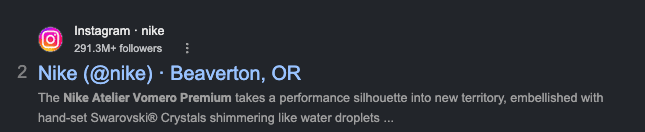
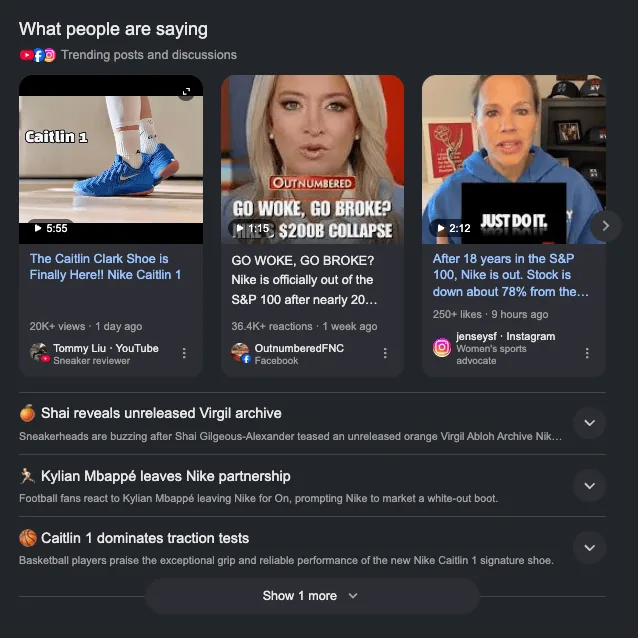
Google doesn’t only show that a profile belongs to your brand. It also pulls details from each profile straight into search results. For Nike, that includes a Profiles row linking to Instagram, Facebook, YouTube, and TikTok, follower counts, recent post text, the location listed on Instagram, and a “What people are saying” carousel of trending posts and discussions. This shows that Google no longer treats your Shopify brand as just a website, but as an entity connected to dozens or even hundreds of attributes.

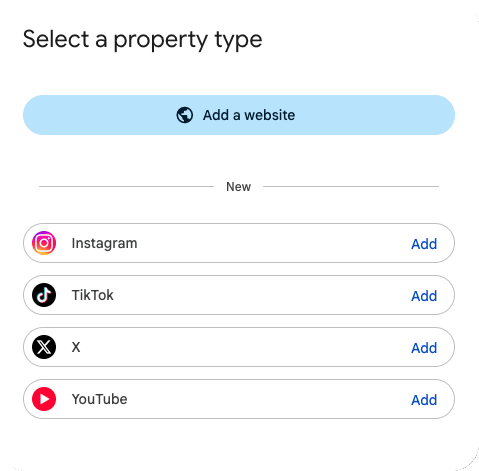
Since July 2026, Google Search Console’s Platform Properties feature lets you connect supported social accounts as individual properties for search performance reporting. Google announced it on July 7, 2026, and rolled it out globally later that month. The feature supports Instagram, TikTok, X, and YouTube. You can view clicks, impressions, and search queries leading to your social content. The feature gives you analytics rather than a direct ranking benefit.
These profiles also give your store its first backlinks. A backlink is a link from one website to another website. Foundational backlinks are basic links that establish a website’s online presence and backlink profile. They commonly come from business directories, social profiles, industry directories, local citations, and relevant listing sites. Foundational backlinks help search engines discover a website, verify business information, and understand its brand, location, and industry.
As covered in Step 4, PageRank values a page by the importance of the pages linking to it. Many social and directory links are nofollow, though, so their main job is discovery and verification, not passing PageRank.
Typical types of foundational backlinks:
- Social profiles: Facebook, Instagram, X, LinkedIn, Pinterest, YouTube, and TikTok. These also secure your brand name everywhere.
- Business directories and citations: Google Business Profile, Bing Places, Yelp, BBB, Crunchbase, and Trustpilot.
- Industry associations and niche directories: for a supplement store, groups like the Natural Products Association.
- Brand profiles: Medium, Substack, GitHub, About.me, Gravatar, and podcast directories.
- Press and company mentions: launch announcements and founder interviews.
I build roughly 20–30 legitimate foundational backlinks for a new Shopify store before focusing on more advanced link building. I use relevant business directories, social profiles, niche directories, supplier or partner profiles, and local citations when applicable. I focus on relevance, accuracy, and quality rather than reaching a specific backlink count. You can check the number and quality of your backlinks with Rankavi’s free backlink checker.
I add structured data and sameAs links to help search engines connect the business with its official profiles and other authoritative identity pages. I use the sameAs property to reference social profiles and other pages that represent the same entity. This strengthens entity identification and reduces ambiguity, but it does not guarantee higher Google rankings.
For a Shopify brand, that means one Organization entity, defined once and reused across the whole site:
@id: one permanent identifier, such ashttps://pawlycbd.com/#organization, referenced the same way on every page.sameAs: only official profiles that genuinely represent the brand, like its Instagram, TikTok, Trustpilot, and Crunchbase pages. More URLs are not automatically better.logo: a stable logo URL that doesn’t change with theme updates.founder: aPersonentity for the founder, with its own@id, connected to theOrganization.addressandcontactPoint: only the details the brand wants public, matching the business profiles exactly.subjectOf: third-party articles, interviews, or press coverage about the brand.publisherandauthor: every article points back to the same#organizationand founder entities.identifier: only legitimate identifiers, like a registered business number. Never invent one for SEO.
Shopify’s default schema is limited. Dawn’s Organization block only includes the store name, logo, and the social links you add under Theme settings > Social media. To add an @id, a founder, your KGMID, or review and directory profiles to sameAs, you have to edit the theme’s Liquid files. In Dawn, the Organization block lives in sections/header.liquid, and product data comes from {{ product | structured_data }} in sections/main-product.liquid. Go to Online Store > Themes > Edit code, and either extend the block in sections/header.liquid or create a snippets/organization-schema.liquid file and render it in layout/theme.liquid. Make these changes on a duplicate theme first. If you work with AI coding agents, you can connect Claude Code or Codex to Shopify’s Dev MCP server, which gives them Shopify’s Liquid documentation and theme validation. Paired with Shopify CLI, the agent can pull the theme, edit these files, and push the changes for you.
On this store, the sameAs list pointed to the same profiles built in this step: social accounts, business directories, and review platforms like Trustpilot and BBB. Once the brand earned its Knowledge Panel, I also added its Knowledge Graph ID (KGMID) to sameAs. That points the markup at the entity Google already recognized. The founder had a separate Person entity with its own sameAs links to personal profiles. I used subjectOf to reference press releases and third-party articles about the brand.
Organization schema: one permanent @id, sameAs links to the KGMID and official profiles, a founder entity, and subjectOf for press coverage.6. Get your brand named in third-party articles
Getting your brand named in third-party articles means getting independent websites, blogs, news outlets, or industry publications to mention your brand in their content. These mentions increase brand awareness, credibility, referral traffic, and online visibility.
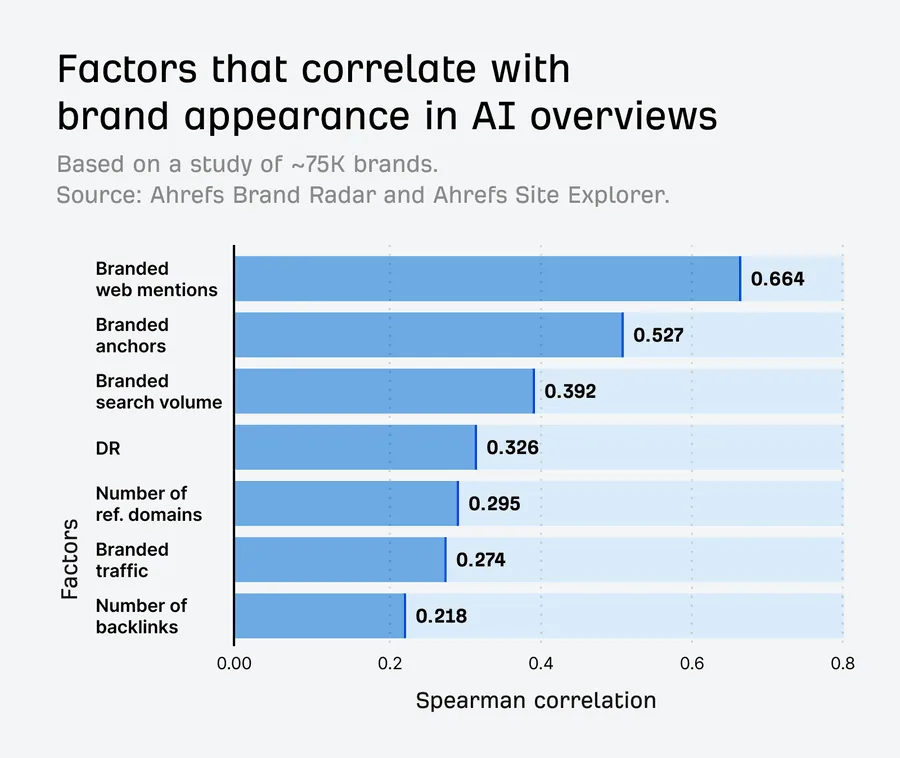
Two separate Ahrefs studies found that brand mentions matter more for AI visibility than backlinks. In a May 2025 study of 75,000 brands, Ahrefs’ Louise Linehan found that branded web mentions had the strongest correlation with AI Overview visibility (0.664), compared with 0.218 for backlinks. Brands in the top 25% for web mentions averaged 169 AI Overview mentions, over 10 times more than the next quartile. In a July 2025 study, Ahrefs’ Patrick Stox found that branded web mentions were again the highest-correlating factor for Google AI Overviews (0.65), though the link was weaker for Perplexity (0.30) and ChatGPT (0.15).
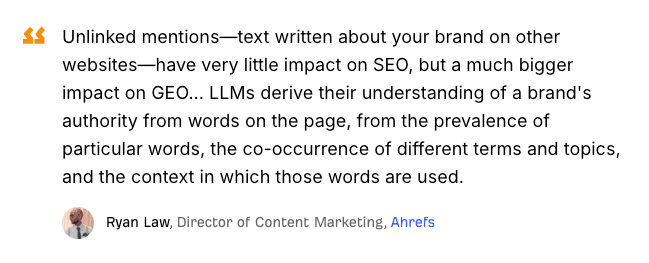
Industry leaders say the same. Ryan Law, Director of Content Marketing at Ahrefs, says unlinked mentions have very little impact on SEO but a much bigger impact on GEO. His reason is that LLMs judge a brand’s authority from the words written about it, how often certain terms appear together, and the context around them.
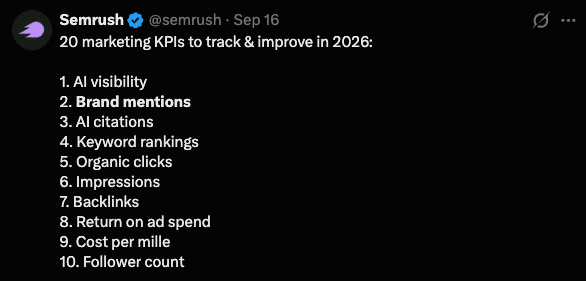
Semrush makes the same point in its list of marketing KPIs for 2026. Brand mentions rank second, right after AI visibility and ahead of AI citations, keyword rankings, and backlinks.
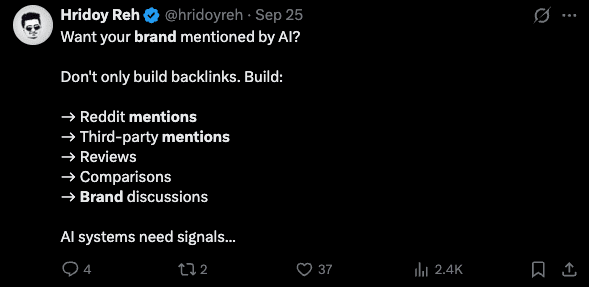
Marketers on X give the same advice. If you want AI to mention your brand, don’t only build backlinks. Build Reddit mentions, third-party mentions, reviews, comparisons, and brand discussions.
The best types of third-party articles for brand mentions are industry guides, expert roundups, product comparisons, reviews, case studies, original research, news articles, and resource lists. “Best X” lists matter most. In a December 2025 analysis of 750 prompts, Ahrefs’ Glen Allsopp found that “best X” blog lists made up 43.8% of all page types ChatGPT cited.
Listicles are articles structured as lists, such as “10 Best SEO Tools” or “7 Ways to Reduce Costs.” AI systems can work effectively with listicles because they organize entities, attributes, and comparisons into distinct sections. Clear headings and concise descriptions can make information easier to extract, compare, summarize, and cite.
Being listed as the #1 choice in relevant third-party listicles can help AI systems associate your brand with a product or service category. Repeated top placements across independent, authoritative sources provide stronger evidence of that association. The same Ahrefs analysis found that brands positioned higher on these lists appeared more often in ChatGPT’s recommendations.
A good listicle compares around 10 relevant brands or options and gives readers enough information to make an informed choice. Each listing should explain what the brand offers, who it is best for, its key features, pros and cons, pricing when available, and the specific use cases it serves. Use the same evaluation criteria for every brand so readers can compare options easily. Include a short explanation of why each brand earned its position rather than simply ranking brands without evidence. Structure the article with clear headings, concise descriptions, comparison tables, and direct answers to the questions people search before making a decision.
You can see this in Google’s AI Overviews. When someone searches for a product, the AI Overview rarely cites the product page itself. The recommendations come from third-party articles, usually “best X for Y” listicles and reviews.
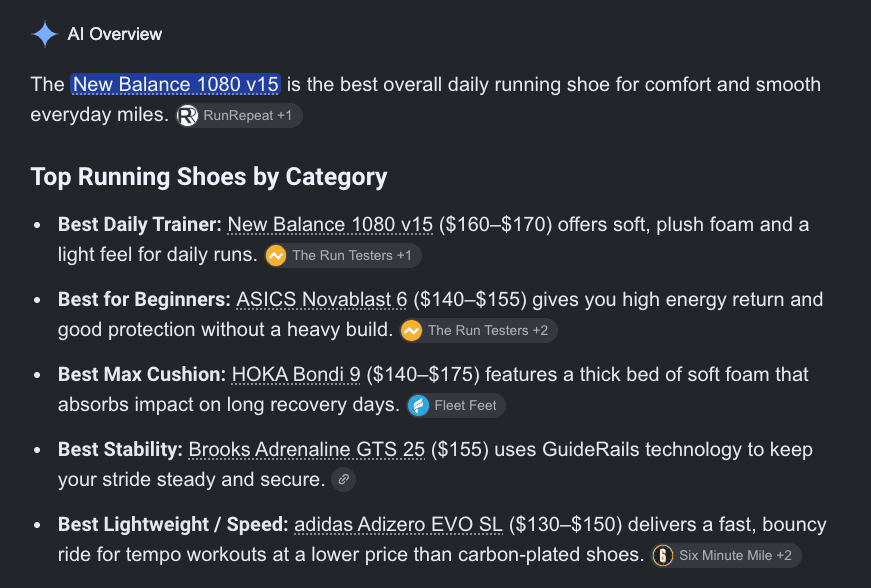
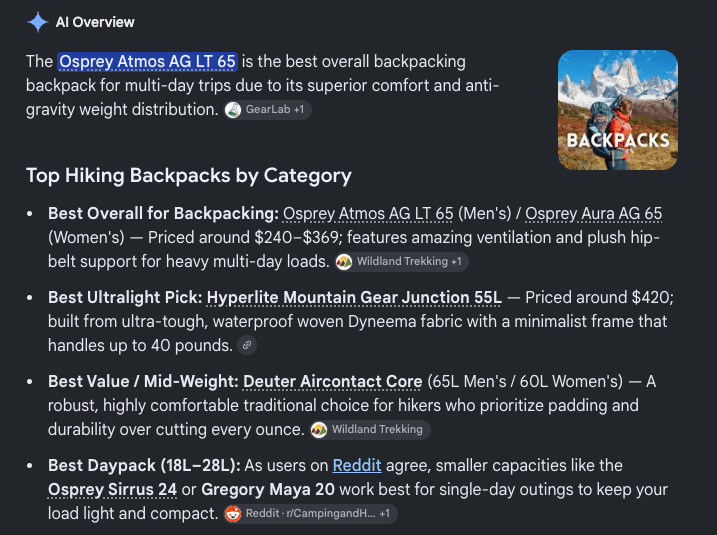
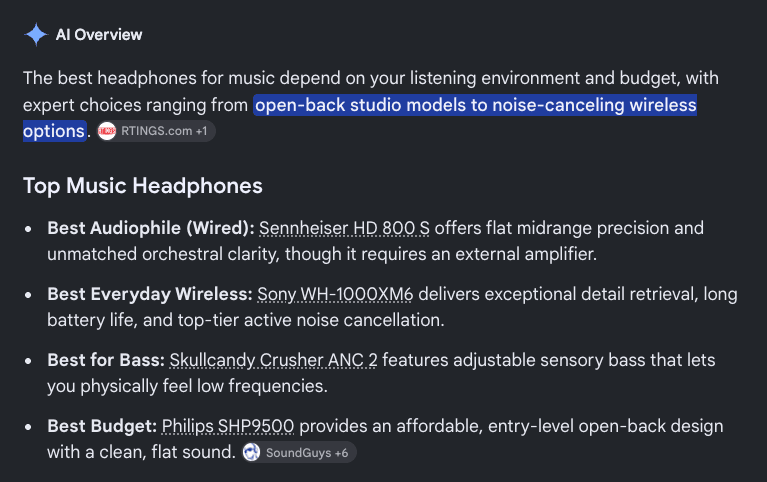
For running shoes, the AI Overview names New Balance, ASICS, HOKA, Brooks, and adidas, but its citations point to RunRepeat, The Run Testers, Fleet Feet, and Six Minute Mile, not the brands’ own stores. The backpack answer cites GearLab, Wildland Trekking, and a Reddit thread. The headphones answer cites RTINGS and SoundGuys. In every case, the brand gets recommended because independent reviewers wrote about it.
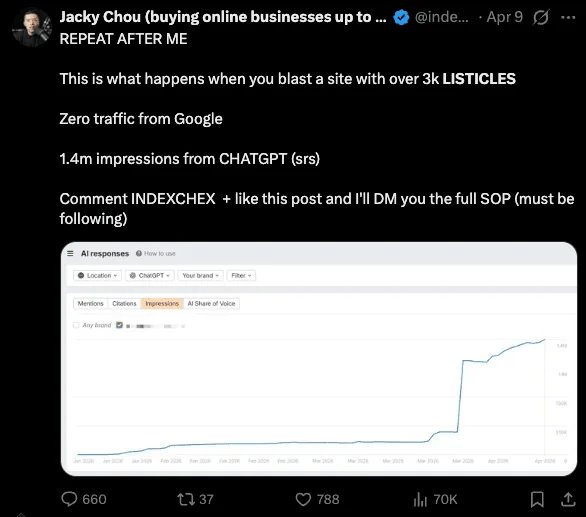
Listicles increase your branded search volume even without linking to your website, because brand mentions create awareness and curiosity. When people repeatedly see your brand in ChatGPT, Gemini, Claude, Perplexity, and AI Overviews, they search your brand name directly to verify your reputation, reviews, pricing, products, or services.
For this launch, I used Rankavi, a software as a service (SaaS) platform that publishes brand mentions in articles on indexed third-party websites. By day 30, the store had been named the top pick for its category in more than 150 listicles. Rankavi places your brand in third-party listicles, reviews, and comparisons at scale. You write the article and name your brand as the top pick. Rankavi publishes it on an indexed website in your niche, and you track every mention from your dashboard. Here’s how it works, from sign-up to a live mention.
7. Send a launch press release
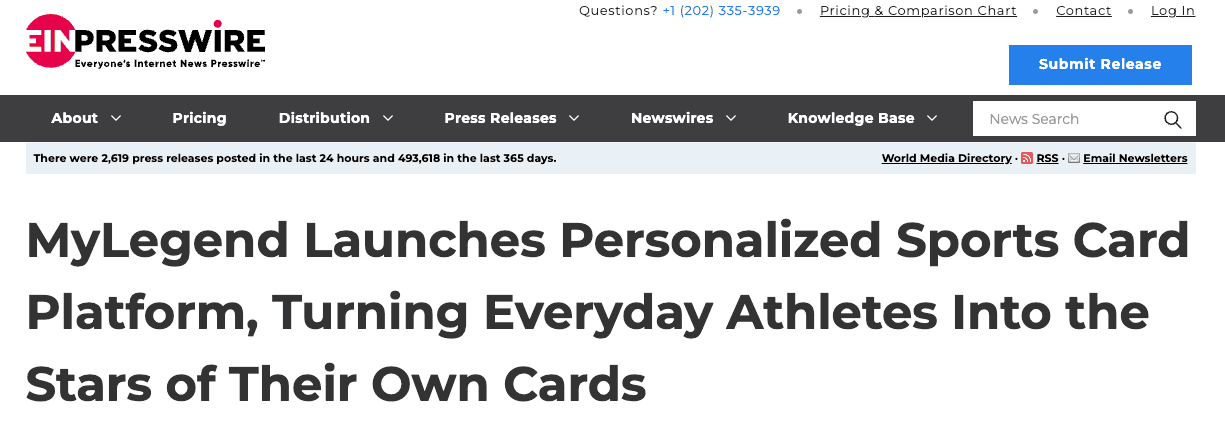
Sending a launch press release means announcing your brand through a newswire, so the story is published on news and PR websites. I sent two press releases for this launch. The goal wasn’t an SEO boost, but an appearance in Google News. No major publication picked up the story, and it only appeared on PR sites. It still added entity recognition, and Google’s AI Overviews used the release to describe the brand.
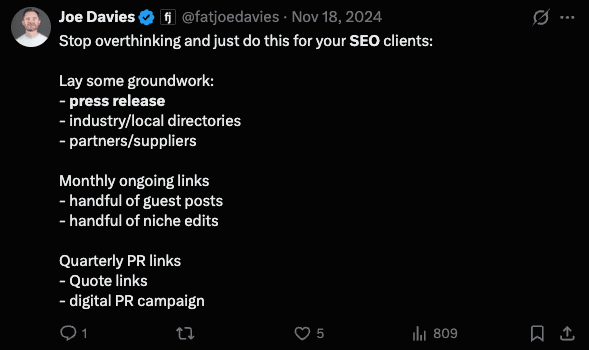
SEOs still treat a press release as groundwork for a new brand, next to directories and partner profiles, not as a ranking tactic.
Press releases don’t help SEO directly. Google’s John Mueller said in 2018:
“We try to ignore links from things like press releases because we know, in general, companies put the press releases out themselves.”
John Mueller, Search Advocate, Google
Google’s spam policies go further and list this as link spam:
“Links with optimized anchor text in articles, guest posts, or press releases distributed on other sites.”
Google Search Central, Spam policies for Google web search
This isn’t new. Back in 2012, Tim Grice wrote on the Moz blog that paying services to send out press releases “is not a link building strategy,” because the same content and the same anchor text go out to many sites at once. In his survey of 20 SEOs, 40% of their clients were spending £2,000 to £3,000 a month on press release distribution.
A good press release has a real news angle, a clear headline, and answers who, what, when, where, and why in the first paragraph. Ideally, connect your brand to another important entity people already search for. For example, a creatine brand could announce “[Brand] Launches Creatine Monohydrate Made with Creapure®.” The release ties the brand to Creapure®, so it can appear in news results when someone searches for Creapure® creatine.
The best press releases share your own data, because journalists pick up original numbers far more often than announcements. At launch, we didn’t have any data yet, so we started with a simple announcement. My mistake was using a commercial keyword as anchor text. Instead of linking the brand name, I linked a phrase like “premium creatine supplement.” That’s exactly the optimized anchor text Google’s spam policy warns about. Link your brand name instead.
8. Build branded search demand before launch
Branded searches are searches that include your brand’s name, and they come in three levels. The first is the brand alone. When someone types “Nike,” Google understands that the searcher is looking for Nike as a brand. The second is the brand plus a product category. Someone searching “Nike running shoes” isn’t just looking for running shoes, but for running shoes made by Nike. The third is even more specific: the brand plus a product or model. Someone searching “Nike Pegasus 41” already knows the exact Nike product they want. For a Shopify brand, the second and third levels matter most, because they come from people who are close to buying from you.
When lots of people look for you by name, Google sees that as a sign your website is good. Google’s Site Quality Score patent, granted in 2015, shows how this works. Google counts how many searches ask for your website by name. Then it compares that with how many searches end with a click on your website. The more people ask for you by name, the better your site quality score, and that helps your pages rank.
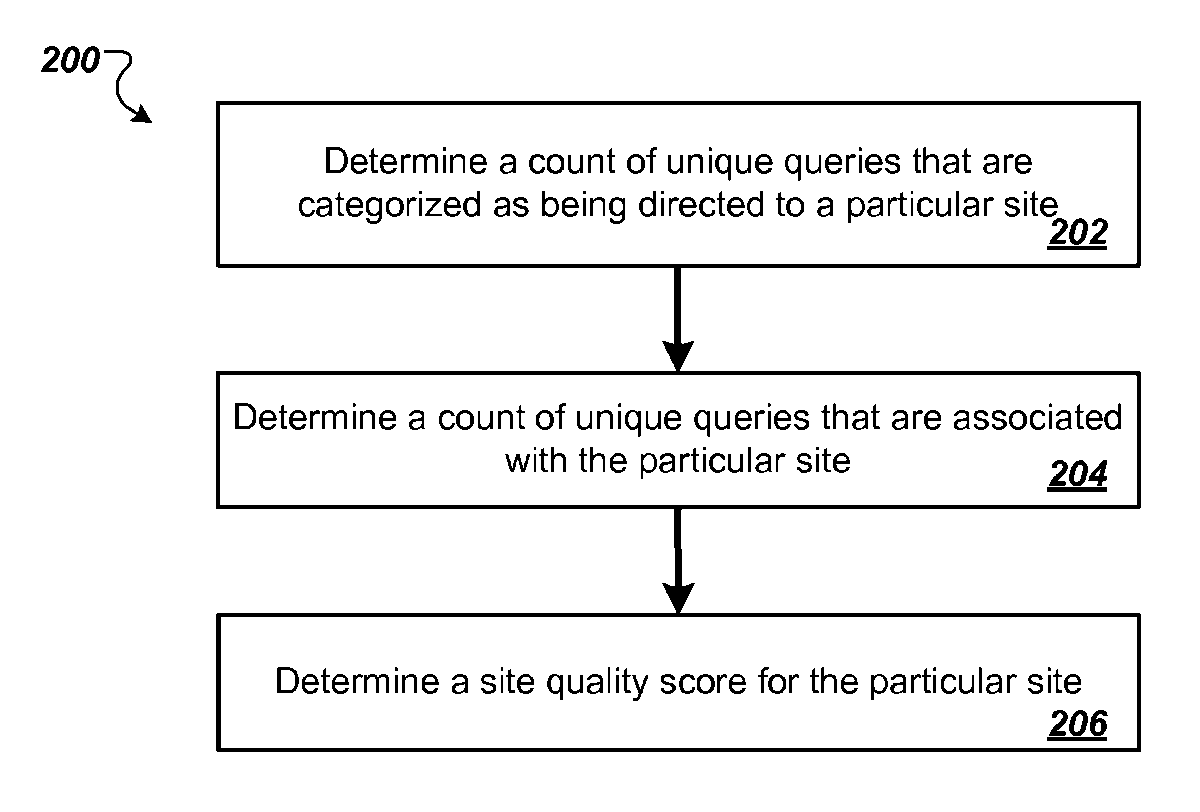
So branded searches aren’t just vanity traffic. A new brand that people already search for by name sends Google a quality signal from day one.
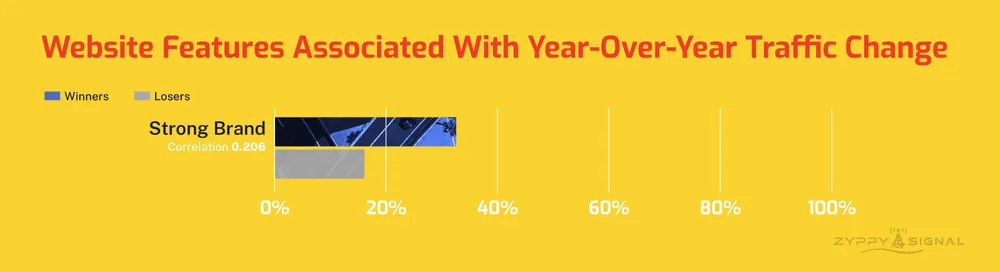
Sites with brand search demand also tend to keep their traffic through Google updates. In an April 2026 study of more than 400 websites, Cyrus Shepard of Zyppy found that 32.6% of sites gaining Google traffic had strong branded search, compared with 16.1% of sites losing traffic. A strong brand was one of five traits that separated the winners from the losers.
Google has said this for years. In 2008, then-CEO Eric Schmidt told magazine executives: “Brands are the solution, not the problem. Brands are how you sort out the cesspool.”
Brand search volume also matters in AI search. In Ahrefs’ study of 75,000 brands, brand search volume was the third-strongest factor linked to AI Overview visibility, well ahead of backlinks.
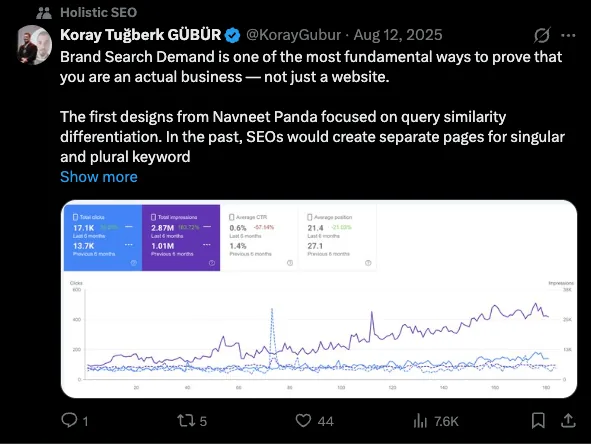
Koray Tuğberk GÜBÜR makes the same point: brand search demand is one of the most fundamental ways to prove you’re an actual business, not just a website.
Building branded search demand means getting enough people to know your brand name that they look it up on Google. Most guides agree on the same tactics:
- Get mentioned on third-party websites. Listicles, reviews, comparisons, and news coverage put your name in front of people who haven’t heard of you, and many of them search it to learn more.
- Build anticipation before launch. Use a pre-launch landing page with a waitlist, product teasers, or an early announcement, so people are already waiting to search for you when the store opens.
- Stay active on social platforms. Post regularly on the platforms your customers use, with the same name, logo, and handle everywhere, so the brand is easy to remember and easy to find.
- Partner with creators. Creators who use your product give their audience a reason to look up your brand after watching.
- Appear on podcasts, newsletters, and YouTube channels. Use a short bio that names your brand and your main product, so listeners know exactly what to search for.
- Collect reviews and customer content. Reviews, unboxing videos, and tagged posts spread your name through the people who already bought from you.
- Publish original data or free tools. Journalists and creators cite useful numbers and tools, and every citation names your brand.
- Keep the name front and center in paid campaigns. Ads on YouTube, Meta, or TikTok that repeat the brand name clearly lead to follow-up searches. This launch didn’t use paid ads, but it’s the fastest way to add demand if you have the budget.
9. Lift the store password at the right moment
Lifting the store password at the right moment means opening the store only after the on-site and off-site work is ready. Some launch tasks have to happen before the password comes off, and some can only happen after. Google, Meta, and Pinterest can’t read a password-protected store, so anything that needs them to see your pages has to wait. Until then, the password page works as your coming soon page. Here’s the Shopify store launch checklist I use.
Before you lift the password
This pre-launch checklist covers everything you can finish before the store can go live.
- Remove any leftover
noindextags and customrobots.txt.liquidrules added during development. - Set up URL redirects for any old or changed URLs.
- Publish your refund, privacy, terms of service, and shipping policies, plus a contact page.
- Place a test order in Shopify’s test mode, and check the confirmation emails.
- Validate your product and
Organizationschema by pasting the code into Google’s Rich Results Test. - Run Lighthouse on mobile from your browser while you’re logged in to the store.
- Test the 404 page, site search, contact forms, and every internal link.
After you lift the password
Once you launch your Shopify store, treat the first week as a soft launch and work through the rest of the Shopify launch checklist.
- Verify your store in Google Search Console and submit
sitemap.xml. - Request indexing for your homepage and key collection and product pages with the URL Inspection tool.
- Connect Google Merchant Center through Shopify’s Google & YouTube app.
- Add Google Analytics 4 through the same Google & YouTube app.
- Install the Meta pixel through the Facebook & Instagram app, and verify your domain.
- Install the Pinterest tag through the Pinterest app, and claim your website.
- Import your site into Bing Webmaster Tools from Search Console.
- Re-run PageSpeed Insights and the Rich Results Test on your live URLs.
- Check Search Console’s Page indexing report daily for the first week.
Immediately after launching an ecommerce store is a good time to register for Google Merchant Center, because it lets Google review your website and product data early. That’s what I did the day the password came off. Google Merchant Center lets ecommerce businesses submit product data to Google so products can appear across Google’s shopping experiences. Without Merchant Center, a store cannot access the same product-based visibility through free listings.
For the basics you need to start selling on Shopify, like choosing a plan, a theme, payments, and shipping, follow Shopify’s own setup guide. They matter, but they aren’t what makes a launch work.
What happened after I lifted the password
I took the password off on November 11, 2024. Googlebot returned to the queued URLs within hours and the first product page was indexed in 11 hours. The traffic curve from the very first day shows what an SEO sequence delivers when I do the pre-launch work correctly. On Day 1, the Shopify Analytics view shows 31 real sessions. On Day 2 sessions jumped to 147. On Day 3 they hit 300. And on November 13, just two days after I took the password off, I got the first organic sale, sourced directly from Google. The Shopify MCP chart below via Claude shows organic sessions and sales for the first 48 hours after launch.
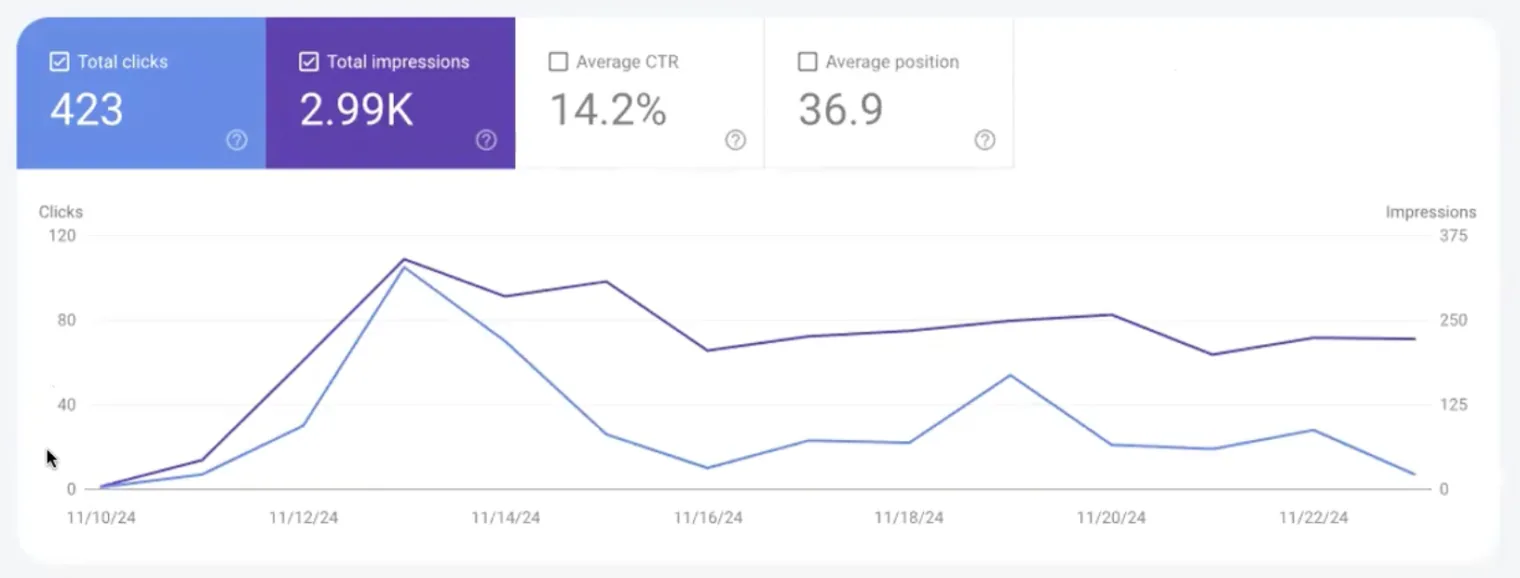
Google Search Console shows what happened in Google search during those same first days. By November 22 (Day 11), the store’s pages had shown up in Google results 2,990 times and been clicked 423 times. On average, they appeared around position 37. About 14 out of every 100 people who saw them clicked, a 14.2% click-through rate. That’s unusually high for a store that had been live for less than two weeks. It happens when a store’s pages answer exactly what people are already searching for.
10. Keep publishing and track your brand recognition
Keeping publishing and tracking your brand recognition means treating the launch as a start, not a finish line. Your launch plan shouldn’t end on launch day. Once the password comes off, promote the brand everywhere you can:
- Keep every social account active. Post regularly on Facebook, Instagram, TikTok, and the other platforms your customers use, with reels, images, and long-form posts.
- Work with creators if your budget allows. We didn’t use influencers for this launch, but creators who use your product can send their audience straight to your brand.
- Run retargeting ads. With your pixels installed, you collect visitors from your blog articles, not just your product pages. Retargeting ads to people who already visited usually cost much less than ads to cold traffic.
- Keep publishing articles. Link every new article to related articles and to your product and collection pages, as covered in Step 4.
- Collect reviews and social proof. Sign up for Trustpilot and collect as many reviews, photos, and videos from customers as you can. Add the best ones to your product pages, and share them on social media. Reply to every single review, positive or negative.
- Keep getting named on third-party websites. Aim for as many relevant placements as you can, month after month.
Knowing how to start a successful Shopify store isn’t the hard part. Success after launch doesn’t come from a handful of placements. It’s constant, repeated work. The more websites mention your brand, the more often AI assistants read about it and name it. The more people see your brand in AI answers, the more of them type it into Google and Bing. That branded demand helps your commercial pages rank higher.
To track your brand recognition, filter your Search Console queries by your brand name and watch branded clicks and impressions over time. Check whether a Knowledge Panel appears when you search for your brand. Then ask ChatGPT, Gemini, and Perplexity the questions your customers ask, and see whether they name you. Here’s what that tracking showed in the first 74 days.
Day 1 to Day 30: the launch traffic mix
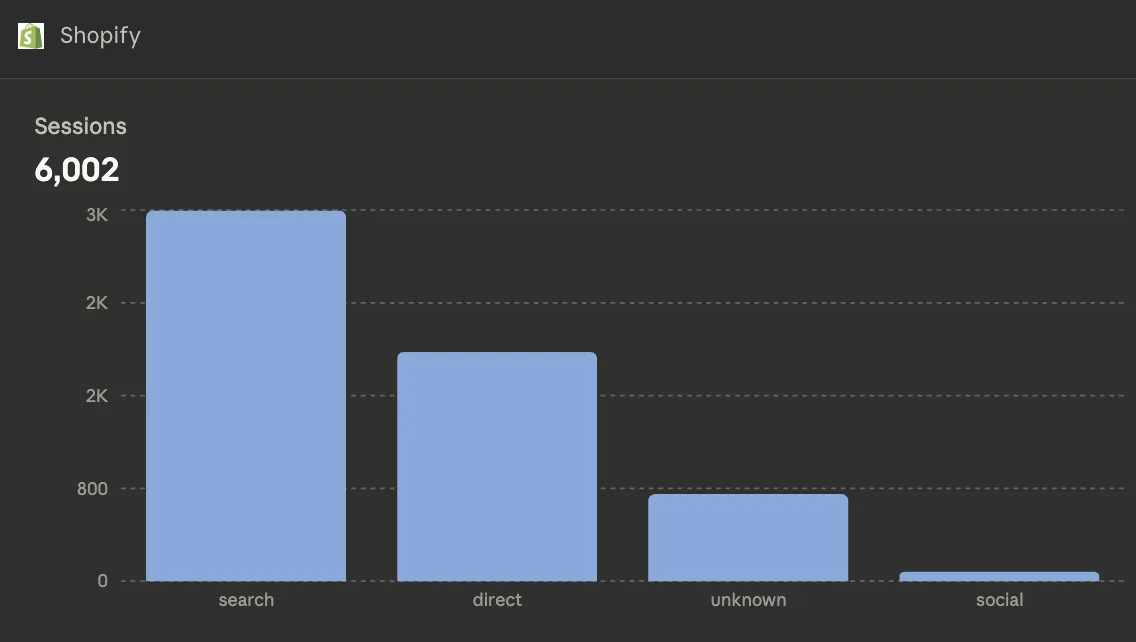
Shopify Analytics shows where the store’s visitors came from in the first 30 days after launch. More than half (53%) came from Google. Direct visits, from people typing the store’s address or using a bookmark, were the second-largest group. The rest came from unknown sources. Only 1.3% came from social media, because the brand had no social following yet. What matters most is what’s missing from this chart: no paid ads, no ad spend, and no retargeting. Every visitor in the first 30 days found the store without a single paid ad, thanks to the pre-launch sequence.
The chart below is a Shopify MCP report via Claude.
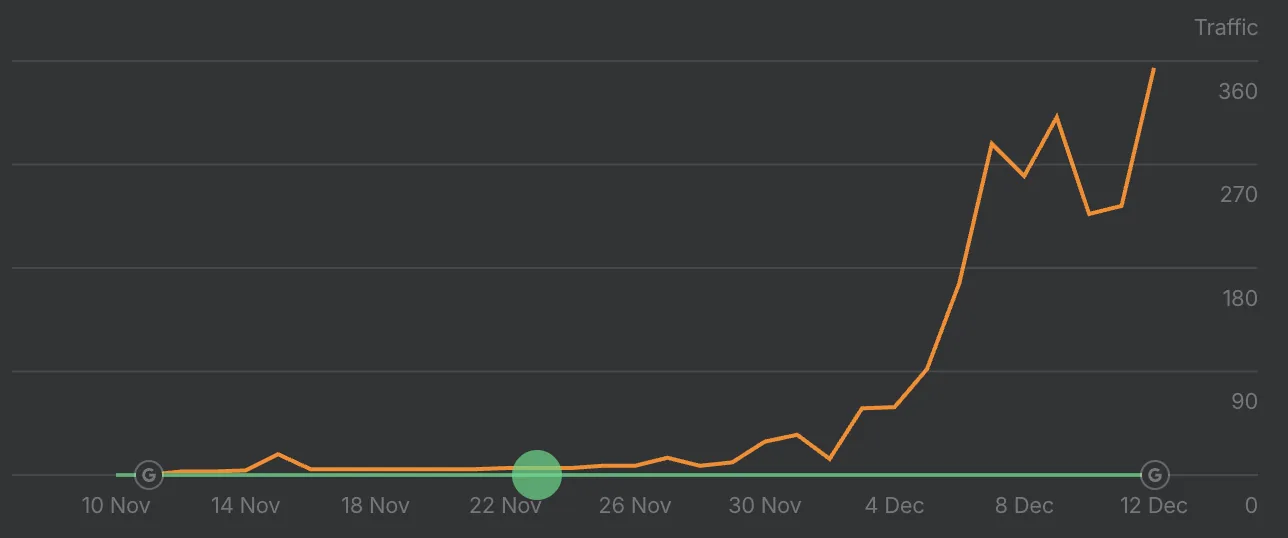
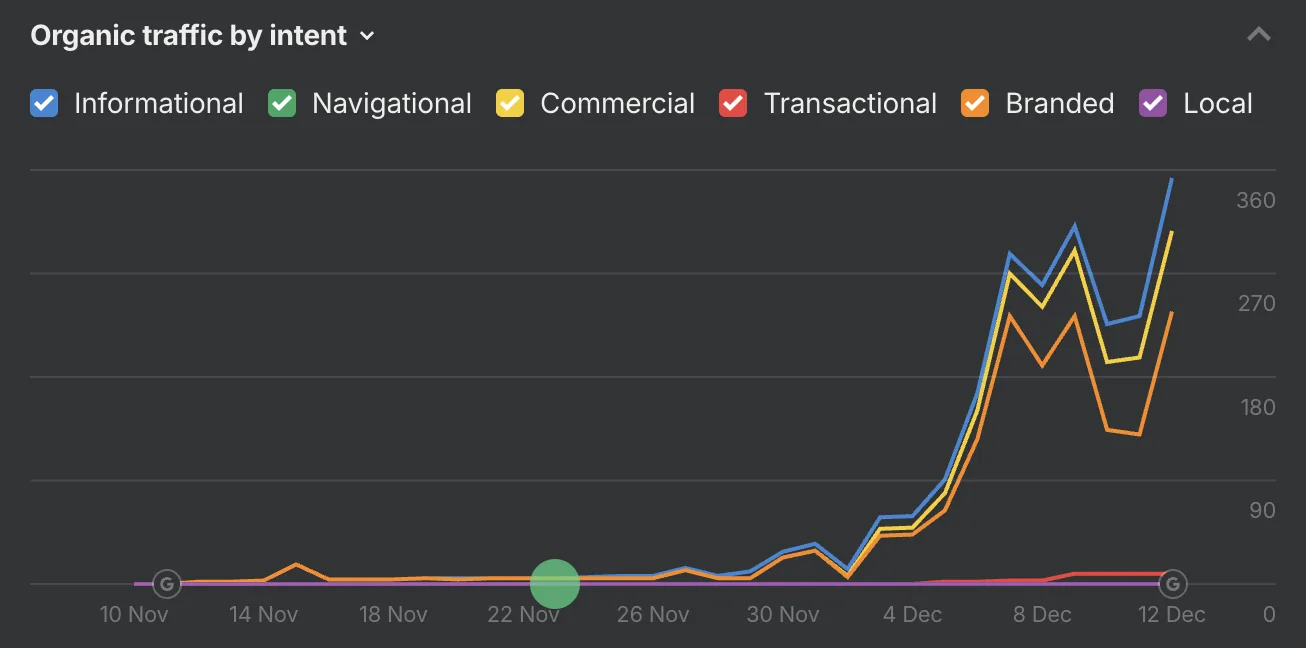
Ahrefs shows the same period from a different angle. Ahrefs estimates traffic from rankings, so its numbers lag behind the real visits in Search Console. In Ahrefs, traffic from Google stayed at zero until mid-November, while Google was still checking the site’s quality. Around November 30, it started climbing as Google showed more of the store’s pages. By December 12, the store was getting an estimated 360 visitors a day from Google. Paid traffic stayed at zero the whole time, because I never ran any ads.
Day 30: Google Knowledge Panel, KGMID, Google autocomplete, AI citations, and 1,045 ranking keywords
By the time we got to Day 30, the store had not only earned a Google Knowledge Panel, it had also started showing branded autocomplete suggestions in Google search, both for the brand name itself and for the products too.
A Knowledge Panel is the box that shows up in the right-hand rail of a Google search result page when Google considers the entity established enough to deserve a structured summary. It pulls together the logo, a description, the founders, the year it was founded, social profiles, and related brands “people also search for.” A KGMID is the unique Knowledge Graph machine ID Google assigns to entities it considers real. It is the same identifier that drives Knowledge Panel eligibility and gets surfaced in AI search results.
Here is what one looks like for three well-known brands across different niches:
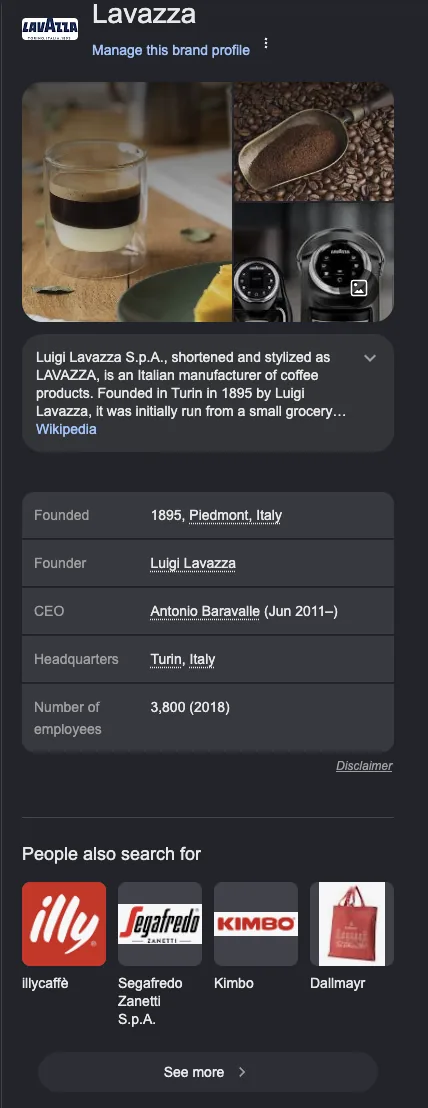
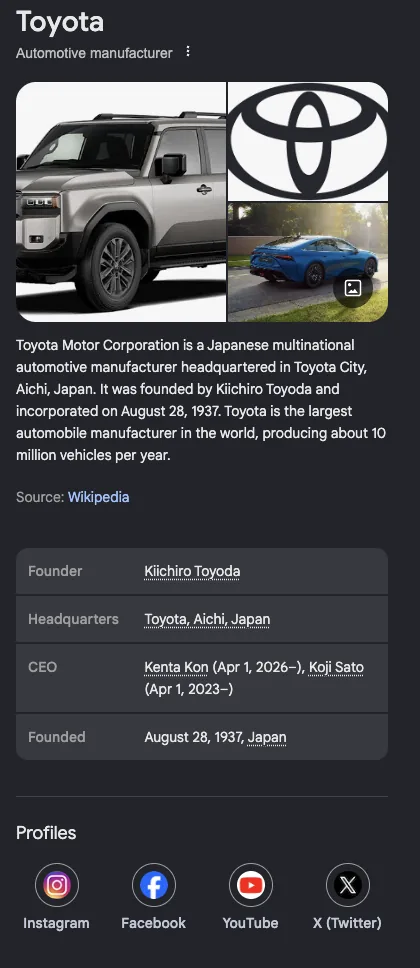
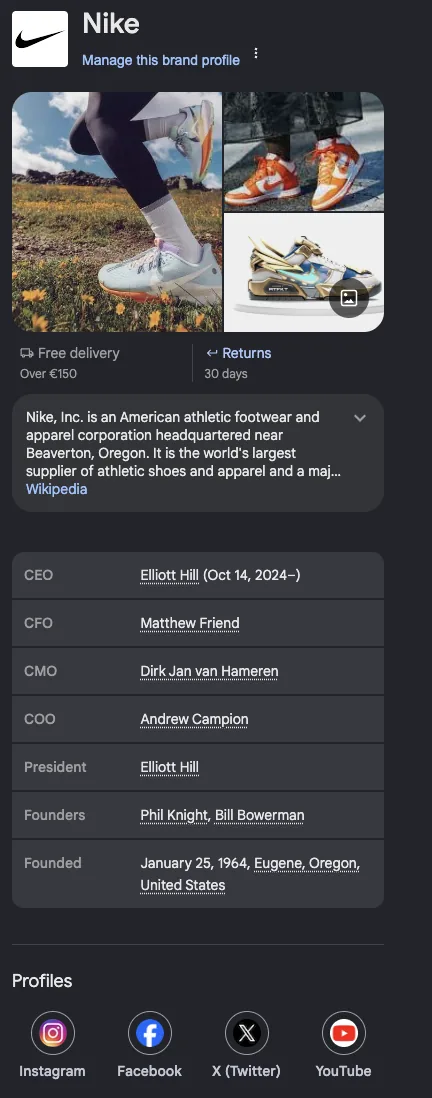
Three well-known brands, three Knowledge Panels. Lavazza launched in 1895. Toyota in 1937. Nike in 1964. When Google introduced Knowledge Panels in 2012, each of them already had decades of press coverage, reviews, and mentions behind it. The store from this case study had none of that history, and it earned a KGMID and a Knowledge Panel in 30 days.
The second signal was Google autocomplete, the dropdown that appears below the search bar and finishes your query as you type. Within the first month, if you started typing the brand name into Google, the dropdown began auto-suggesting branded queries on its own. Not just the brand name, but specific product variations attached to it. Imagine a dog food brand called Barkly. By Day 30, Google would start auto-suggesting “barkly reviews,” “barkly salmon recipe,” “barkly puppy food,” “barkly subscription” before the user finished typing. Here is what autocomplete looks like once a brand has reached this stage, using Hoka as an established example.
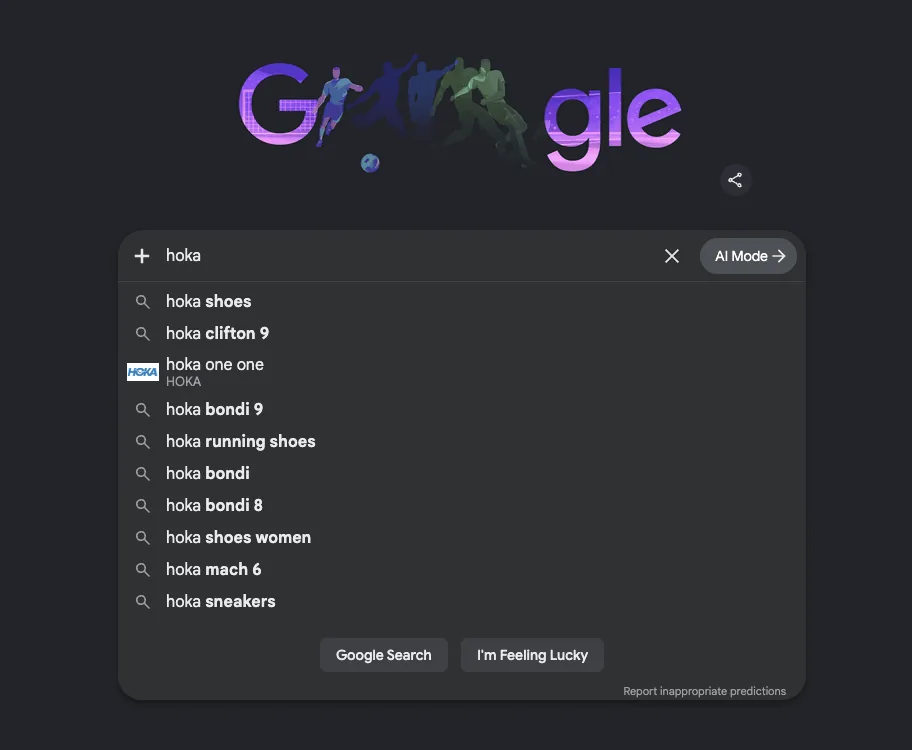
Now, autocomplete isn’t magic. Google explains how it works in its official guide to autocomplete predictions. Predictions reflect real searches, starting with common and trending queries that match what someone types. Google also considers the searcher’s language and location. When interest in a topic rises, Google can show a trending prediction even before it becomes common. Google’s Processing Autocomplete Suggestions patent also describes building suggestions from past user queries. Google doesn’t publish how many searches a new query needs. But a recent surge of real searches for a new brand name can be enough to get it into the dropdown.
Branded autocomplete and a Knowledge Panel are not features you can apply for. They show up when the off-site sequence has put enough mentions into Google’s index that the algorithm starts treating the brand as a recognized entity. For a brand-new entity, this normally takes months or years. The reason it took me under 30 days is that I had already seeded enough brand building signals across the open web before the store opened that real buyers were searching the brand name and product variations from the first week. Those searches were what pushed the queries past the autocomplete threshold.
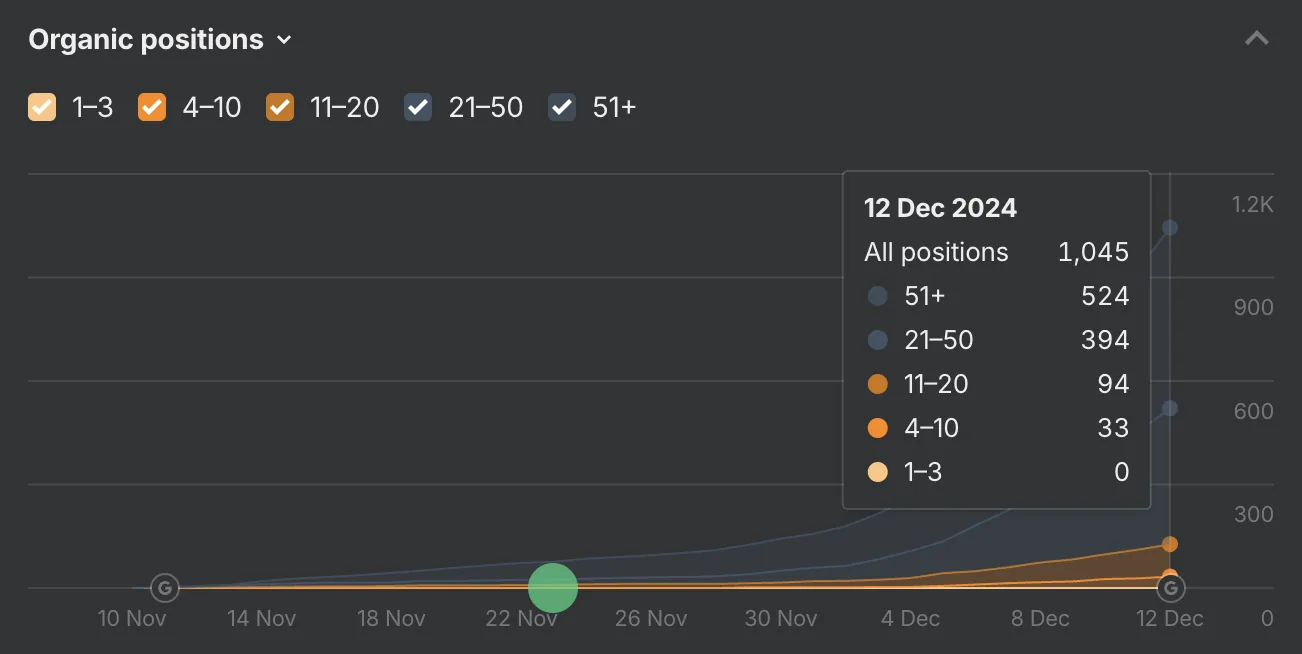
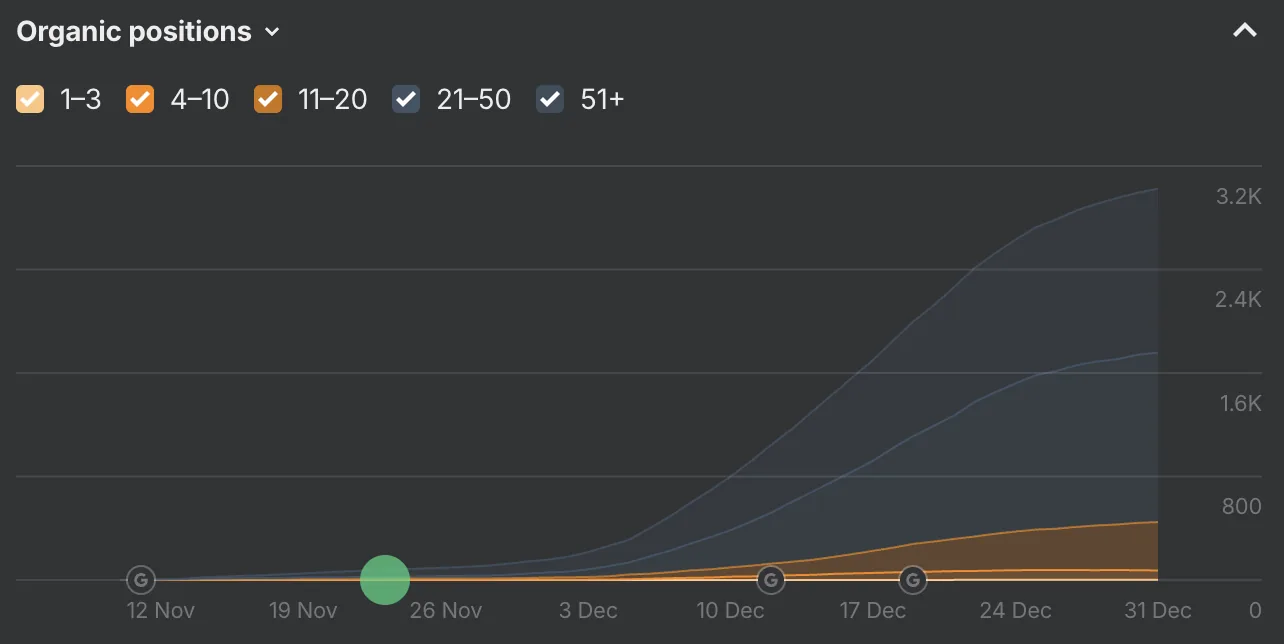
By December 12, the Ahrefs view of the domain showed 1,045 ranking keywords already distributed across the position buckets: 524 in positions 51+, 394 in positions 21 to 50, 94 in positions 11 to 20, and 33 in positions 4 to 10. The shape of the curve matters more than the absolute numbers: every position bucket climbed at the same time, which means the brand was not winning one lucky head term, it was building topical breadth across the entire niche from the start.
Ahrefs also splits the same window by search intent. Informational, commercial, and branded traffic climbed together, reaching about 260 to 380 estimated daily visitors by December 12. Navigational, transactional, and local stayed near zero. Ahrefs can tag one keyword with several intents, so these lines overlap. Still, the informational and commercial growth shows the store was showing up for shopping and research questions, not just its own name.
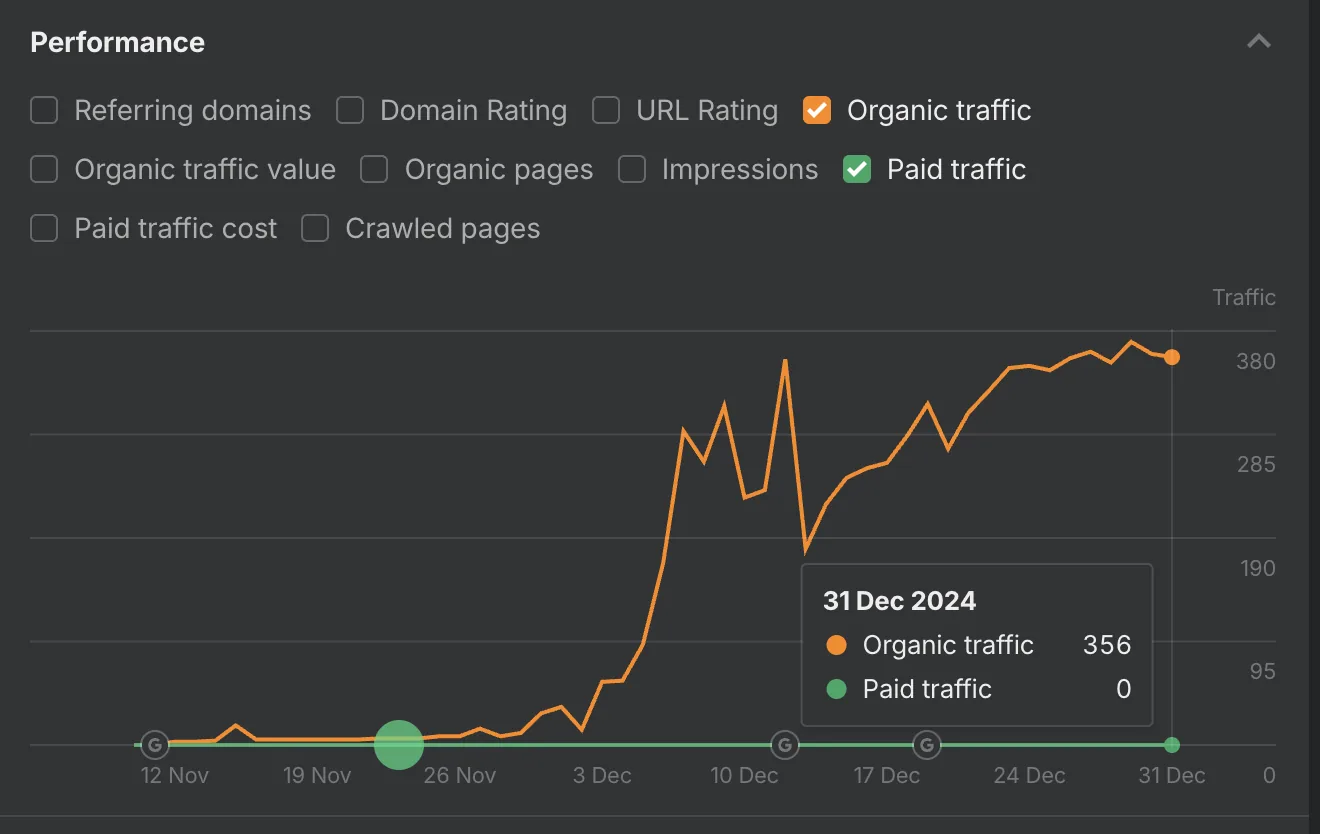
Day 50: 3,200+ keywords ranking, traffic climbing to 356 daily
By December 31, 2024 (Day 50 after launch), the store showed up in Google for about 3,200 different searches. Ahrefs calls these ranking keywords. Most weren’t on page one yet, which is normal for a brand-new site. About 90 were on Google’s first page, and about 500 were on page two. Around 1,450 were on pages three to five, and about 1,200 were further back. What matters is that every group grew at the same time. Keywords usually start low and climb, so a big base of lower rankings is where future first-page results come from.
Daily organic visitors reached 356 by December 31, with paid still at zero across the entire window.
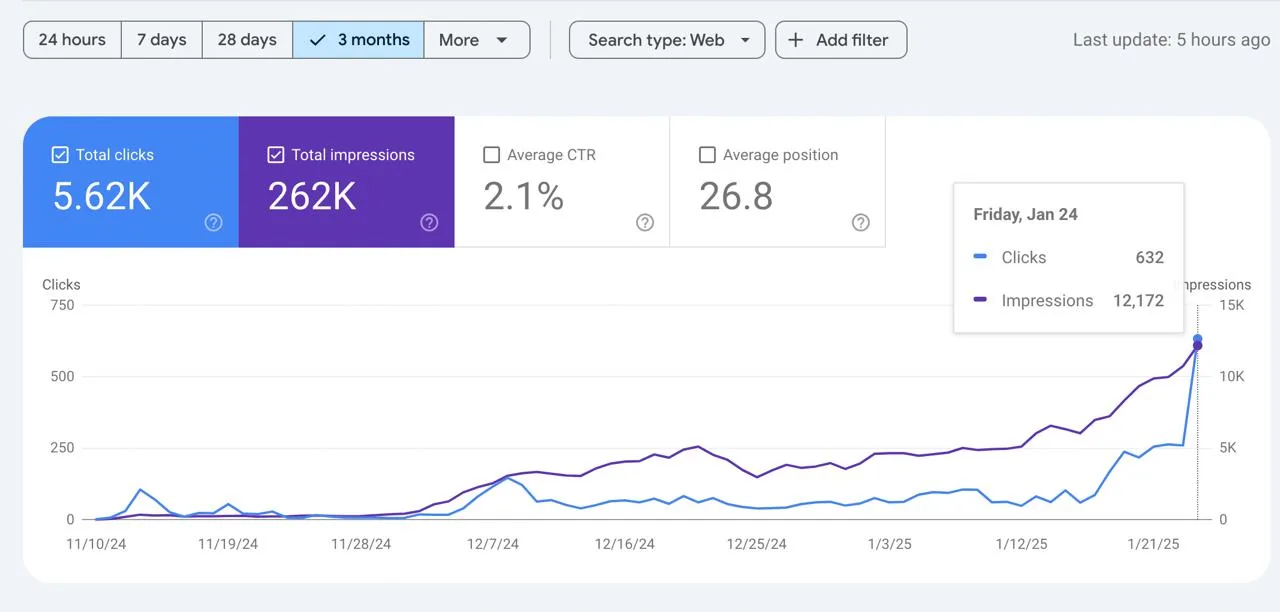
Day 74: 5.62K clicks, 262K impressions, average position 26.8
The Google Search Console view at day 74. Between November 11, 2024 (launch day) and January 24, 2025, the brand accumulated 5.62K total clicks and 262K total impressions against an average click-through rate of 2.1% and an average position of 26.8. The single peak day, Friday January 24, alone delivered 632 clicks and 12,172 impressions. The trajectory is the classic SEO hockey-stick: a low baseline for the first three weeks (a few dozen clicks a day, small next to the later peaks) while Googlebot completed its initial quality assessment, then a steady climb starting in early December as the index opened up to the domain.
Sales started small, as they do for any new brand. But they grew fast: up 167% in December and another 550% in January. By the end of January, monthly sales were about 17 times the launch month, with no paid ads behind them.
What are the results after starting a Shopify store?
- 151K clicks
- 23.6M impressions
- Average position 9.9
The trajectory did not stop at 75 days. The chart below shows Google Search Console performance from February 17, 2025 through November 17, 2025, the nine months following the initial case study window. Total clicks reached 151K. Total impressions reached 23.6M. The average position climbed from 26.8 in the first 75 days to 9.9 in the months that followed. The average CTR moved from 2.1% to 0.6%, which is the normal pattern when a domain expands its topical map where individual queries have lower click rates but the total click volume compounds. A single day during this window broke 2,300 clicks. The growth shape is also visible: a slow first quarter while existing ranking pages stabilized, then an inflection around September 2025 where the curve accelerated into a daily click count that more than doubled within six weeks.
What are the advantages of launching a Shopify brand with an SEO sequence?
The top five advantages of launching a Shopify brand with an SEO sequence, instead of launching cold, are:
- Brand awareness from day one. People already know your name and search for it when the store opens, instead of discovering it months later. You don’t pay for months of awareness ads just to get your name known.
- Early organic sales. Search traffic brings in buyers in the first weeks, not after months of waiting for Google to notice you. You don’t hand an affiliate a commission on every early sale.
- Faster trust from Google. The store is complete the first time Google crawls it, so it passes the first quality check instead of being filed as a low-quality site. You don’t spend months buying traffic while Google decides whether to trust you.
- Recognition by AI assistants. ChatGPT, Gemini, and Google recognize your brand through third-party listicles, reviews, and comparisons, and use these signals to recommend it.
- Less dependence on paid ads. Organic traffic and brand searches bring the first customers, so you don’t have to buy every sale. You don’t need a nonstop supply of winning ads to keep sales coming.
Most new stores never get this head start. They open cold, wait months for search traffic, and pay for ads to make every early sale.
What happens when you launch a Shopify brand without an SEO sequence?
Launching a Shopify brand without an SEO sequence reduces organic traffic, increases customer acquisition costs, and delays revenue growth. Most new ecommerce brands rely heavily on paid ads when SEO is absent. Stefan Georgi, one of the best-known DTC marketers in the world, explained in his newsletter that almost all DTC marketing now happens at the ad level. The problem? When every customer comes from ads, your customer acquisition cost (CAC) rises and falls with ad prices. If acquiring a customer costs more than that customer spends, every new sale loses money.
There’s a trust problem too. When a customer Googles a brand without a digital footprint, they find the store’s own pages and nothing else. No reviews, no Knowledge Panel, and no articles about it. Ask ChatGPT, Gemini, Copilot, or Perplexity “Is X legit?” or “Who owns X?”, and you get nothing useful. Or worse, the engine assumes you misspelled an established competitor and “helpfully” suggests a brand that’s been around for years.
How long does it take to start a Shopify store?
Starting a Shopify store with an SEO sequence takes about one to three months of work before launch, depending on your niche. Setting up the store itself takes days. Building everything Google and AI assistants need to see on the first crawl takes longer. How long it takes depends on:
- Access to your products. If you manufacture your products or have them in hand, you can take real photos and cover every attribute. If you dropship, getting real images and details takes longer.
- Early reviews. If you can send samples to people before launch, you can open with real reviews instead of none.
- Your budget and time. A bigger budget buys more articles, placements, and help.
- Whether you work alone or with a team. One person writing every page moves slower than a team splitting the work.
- Whether you do SEO at all. If you plan to rely only on paid ads, you can launch in days, but you skip everything this case study covers.
How much does it cost to start a Shopify store?
How much it costs to start a Shopify store depends mostly on whether you do the work yourself. If you do it alone, the main cost is your time, plus a few subscriptions. Here’s what the setup in this case study costs at current prices:
- Shopify Basic plan: $39 a month, or $29 a month billed annually
- Domain: about $10 to $20 a year
- Theme: $0 with Shopify’s free Dawn theme
- Google Search Console, Merchant Center, and Analytics: free
- Trustpilot: free plan available
- Press release: $149 for one release on EIN Presswire
- SEO tool (optional): Ahrefs Lite at $129 a month, or $99 a month billed annually
- Brand mentions: $15 per mention on Rankavi, or $12 per mention in a 50-credit pack. 150 listicles, like this launch, come to about $1,800.
If you’d rather have someone who has launched Shopify stores guide you through it, you can book a consultation with me.